
Updates
Navigating the Challenges of Amazon Product Compliance for Sellers
April 18, 2025
Urgent News to Sellers on Amazon
Amazon is cracking down and identifying ASINs on their website as products that emit radio frequencies. Amazon is requiring – and enforcing – proof of Federal Communications Commission (FCC) compliance information for these products and all products that emit radio frequencies in order to list on Amazon.com. You can provide this information through the FCC Radio Frequency Emission Compliance Attribute. On March 7, 2022, Amazon will begin removing ASINs from the store that are missing required FCC information until that information is provided.
If you do not currently have your required FCC certification, contact Testing Partners immediately for product construction review, pre-compliance review, compliance plan for determining applicable standards and requirements for your product, and complete testing and certification.
Supplier’s Declaration of Conformity (SDoC) is an FCC equipment authorization procedure that requires the party responsible for compliance to ensure that the equipment complies with the appropriate technical standards. Testing Partners provides SDoC Services for importers and manufacturers outside the United States shipping product into the U.S. We will serve as the contact point for any inquiries from the FCC. We will also serve as trans-shipment point for audit samples that may be requested by the FCC.
Testing Partners is also an Amazon service provider for compliance and can proactively assist with assessing your product to determine requirements that will permit you to sell on Amazon.com BEFORE they pull your product. Knowing the Amazon, FCC, or global compliance requirements before you place your product in the marketplace will save you time, money, quality assurance issues, consumer safety issues, and negative impacts on brand reputation. Call 862-243-2677 or email customerservice@testingpartners.com right now!
The Benefits of Selling on Amazon
Every business is unique in terms of its products, services and its long-term vision for growth and markets. Utilizing Amazon’s platform to sell a business’ products has both pros and cons to consider in determining if it is a fit with those plans.
Avoiding the heavy lifting of creating an in-house sales platform plus Amazon’s unquestionable market reach are strong arguments for its use, whereas brand dilution, weaker customer relationships, and competition from Amazon itself may be disadvantageous.
Meeting Listing Requirements
Assuming a seller decides the balance of pros and cons of selling on Amazon are in their favor, what’s next? There are a number of first qualification steps that are fairly easy to accomplish:
- Provide an EAN or UPC barcode and an SKU
- Provide detailed product and company descriptions
- Determine sales volume, prices and shipping options
- Select a product category, which may trigger additional requirements
In addition to these prerequisites, a significant hurdle for sellers that is often overlooked is navigating the extensive Amazon product compliance procedures for safety, labeling, and other market regulatory directives. Although for certain product categories product compliance requirements are minimal, many products fall under “locked” categories that require strict compliance pre-approval by Amazon before being granted a listing.
Responsibility for Product Compliance Belongs to the Seller
Any seller on Amazon is ultimately responsible for meeting all relevant safety and labeling standards plus documentation requirements for their listed products. Amazon itself does not set product compliance standards but requires traceable evidence of such compliance.
The particular standards requirements and the necessary compliance steps vary depending on the product category and the target market in which it is sold, e.g. Amazon.com, Amazon.de, Amazon.co.uk, etc.:
- Safety and chemical standards
- Labeling requirements
- Lab tests
- Declarations of Conformity
Once these are established, the seller should work with their suppliers who may more easily make pre-production changes to accommodate meeting these conditions.
Can the Product Supplier Provide Compliance Data?
If the products are being sold in the country in which they are manufactured, then the supplier should already comply with relevant safety, labeling, and documentation requirements and have recent product compliance documents to share. However, it is not the responsibility of suppliers to ensure compliance of their products sold in foreign countries nor to ensure these adhere to Amazon product compliance policies.
In any case, even when suppliers have documentation, such as test results or declarations of conformity, they may not be current or may not otherwise satisfy Amazon’s documentation standards. For instance, all compliance data and supporting documentation must bear the seller’s company name not that of the supplier.
How to Discover Directives and Standards That Apply to the Product
Procuring whatever documentation a supplier has, even if it is spotty or out of date, provides a seller a foundation from which to build to meet Amazon’s compliance process.
Beyond that, if a product category has even moderate safety or other requirements, sellers likely need to consult someone knowledgeable in this area such as an attorney or a specialized consultant. Building a relationship with a domain expert is also recommended to avoid having a product de-listed or inventory destroyed by Amazon because it runs afoul of a later compliance standard changes.
Amazon Will Not Be Much Help
Unfortunately for sellers, Amazon typically provides only general guidance on what standards or directives apply to the products being listed. Often, if a seller submits compliance data or test results that are not complete, out of date or otherwise deficient in the eyes of Amazon, they will reply with a brief, undetailed message that may read something like this:
“Please provide a verifiable declaration of conformity that includes all relevant, mandatory safety standards. We do not accept your test report.”
Ensuring Successful Amazon Product Compliance the First Time
Unexpected delays in Amazon product compliance approval due to an incomplete understanding of how the process works or which standards apply can cost sellers many thousands of dollars. This is especially true if they must endure multiple trips through the procedures.
Start as Early as Possible
If compliance pre-approval is a given, sellers must start the process well before the product is otherwise ready for listing. Compliance may take weeks or even months to complete, which could easily disrupt a seller’s carefully crafted supply schedule or marketing campaign.
Even if the seller does manage an early start, first-time product compliance is a rare event without the help of compliance experts. Sellers typically do not have the necessary equipment to perform tests let alone the knowledge and experience to navigate the arcane complexities of the regulatory landscape.
Seek Help From Compliance Experts
Product compliance testing consultants, such as Testing Partners, are specialists in verifying products that are developed by or supplied to Amazon sellers are in complete compliance with any and all applicable state, federal or international regulations. They guarantee acceptance by the Amazon product compliance process. Sellers enjoy a worry-free journey that lets them traverse the Amazon product listing maze the first time through in the shortest time possible.
Avoid Amazon Product Launch Disruption Due to Compliance Issues
On Amazon, the product mix is ever-changing and growing. It is estimated that 75,000 new products are listed on Amazon every day of which many compete with one another.
Add to that a complex and in-flux product regulatory environment, and it is easy to see that delays in product listing can be detrimental to margins and the bottom line for Amazon sellers. Testing Partners hosts a Late to Market Calculator that can help quantify such losses.
Thus, it is critical for sellers to move through the product listing process rapidly, which for many means getting Amazon product compliance right on the first try. Call Testing Partners today at 1-833-COMPLY8 to learn how they can simplify and streamline Amazon product compliance for you.
This is the first part is a series of posts about Amazon Product Compliance. Check back for part 2 in the coming weeks.
New Terrain for E-Bike Safety Regulations
April 19, 2024
The U.S. Consumer Product Safety Commission (CPSC) has issued an Advanced Notice of Proposed Rulemaking (ANPR) aims to address the hazards associated with electric bicycles (e-bikes). Precursors to Notice of Proposed Rules (NPRs) and Final Rules, ANPRs are a critical public consultation process. This ANPR seeks to bolster the safety protocols of electric bicycles (e-bikes), a rapidly expanding segment within the low-speed transportation market. This initiative, invoking the authority of the Federal Hazardous Substances Act (FHSA), marks a decisive step towards heightened CPSC oversight in response to mounting injury data. As e-bikes, known for their electric motors that enable both partial and fully electric propulsion, increasingly navigate our streets, the CPSC’s intensified scrutiny underscores a growing commitment to public safety and consumer protection.
Product Scope: The Diverse Landscape of E-Bikes
E-bikes encompass a wide range of bicycles integrated with electric motors, which may augment the rider’s pedal power or replace it entirely with a throttle mechanism. These innovative modes of transport cater to a variety of uses—from city commuting to off-road exploration. A defining feature of the e-bike is the pedal-assist system, which amplifies the rider’s torque, enhancing mobility and ease of travel. Alternatively, throttle-equipped e-bikes offer motor-powered propulsion independent of pedaling effort, often controlled by a thumb-operated device on the handlebar.
Regulated under 16 CFR part 1512, “low-speed electric bicycles” are defined by their power output and speed capabilities; specifically, motors must not exceed 750 watts (1 horsepower), and the e-bike must not surpass 20 mph on level ground under motor power alone with a standard-weight rider. Notably, this regulation does not impose a speed cap for pedal-assisted scenarios. E-bikes that don’t meet these criteria, yet are not classified as “motor vehicles” for public roadway use, also fall under CPSC’s purview.
Furthermore, the CPSC recognizes the presence of e-bikes designed for children, such as electric balance bikes without pedals, which aid in developing balance and coordination by allowing propulsion through the rider’s leg power. The current rulemaking focuses exclusively on the e-bike category, distinctly excluding gas-powered bicycles, traditional non-powered bicycles, and children’s battery-powered ride-on toys governed by other safety standards.
Hazards Associated with E-Bikes
In a recent evaluation of e-bike-related safety concerns, the CPSC scrutinized data from the “Micromobility Products-Related Deaths, Injuries, and Hazard Patterns: 2017—2022” report. This in-depth analysis revealed a startling 53,100 estimated injuries linked to e-bike incidents between 2017 and 2022, accounting for 15 percent of all micromobility injuries reported during that period. Notably, there was a sharp increase in emergency department-treated injuries associated with e-bikes, surging from 3,538 in 2017 to 24,335 in 2022.
Regarding fatalities, the CPSC recorded 100 e-bike-related deaths from 2017 to 2022, escalating from none to 41 deaths in this period. Helmet usage was reported in only 16 of these cases, with 13 riders not wearing helmets at the time of the incidents. A majority of the fatalities involved collisions with motor vehicles, while others were attributed to falls, control issues, and collisions with fixed objects, curbs, and pedestrians, with one incident involving a rider ejection.
The CPSC identified various mechanical hazards through the Micromobility Report and the Consumer Product Safety Risk Management System (CPSRMS). Among these hazards were crank arm and pedal detachments, tire failures, brake failures, wheel detachments, issues with rider stability, broken frames, motor shutoff problems, unintended acceleration, and chain and throttle issues.
Regulatory Framework for E-Bike Safety
The CPSC sets forth safety standards for bicycles, including e-bikes, under part 1512, established in 1974 and updated until 2011. This rule outlines mechanical standards akin to those for traditional bicycles, such as requirements for the braking system, steering, pedals, drive chain, tires, wheels, and reflectors, ensuring a foundational level of safety. However, part 1512 doesn’t address the specific needs of e-bikes powered entirely by electricity.
Additionally, ASTM standards for bicycle structure and components are currently in place but lack provisions unique to e-bikes, as they primarily target human-powered bicycles. Although some standards like ASTM F2043–13 (2018) and ASTM F2680 (2017) could be relevant, they may not cover all aspects of e-bike design.
Acknowledging these limitations, the CPSC there’s a clear need new safety standards that address the distinctive features and risks of e-bikes, ensuring their safe integration into the transportation framework.
Moving Forward
The CPSC’s ANPR is a proactive step towards crafting a safer future for e-bike users. This early stage of regulatory development is designed to gather insights and open a dialogue on the best paths forward for e-bike safety regulations. The CPSC’s objective is clear: to enhance safety standards while recognizing the growing role e-bikes play in modern transportation. Performance requirements, technological innovations, and market trends will all be considered to establish a comprehensive regulatory framework.
As this process unfolds, the voices of consumers, manufacturers, and safety experts are invaluable. The feedback and commentary provided on the ANPR will be instrumental in refining the exact requirements for the final rule. This collaborative effort is pivotal in ensuring that the resultant regulations balance safety with practicality, thereby facilitating the integration of e-bikes into our daily lives as a safe and sustainable mode of transport.
Anatel Updates on Technical Requirements for Mobile Phone Chargers
April 17, 2024
On April 17th The National Telecommunications Agency (ANATEL) published the new Act 5155 with testing requirements for mobile phone chargers. This act will come into effect on October 14th, 2024, replacing Act 5159
The main changes with the new Act 5155:
- Electrostatic Discharge (ESD) Levels for Vehicular Chargers: Under the new Act, the ESD requirements for Vehicular Chargers have been refined. Specifically, ESD must now comply with Item 8.3 of ISO 10605/2008, with levels set at 6 kV (removed 2/4kV) for contact discharges and 8 kV (removed 4/6kV) for air discharges.
- Streamlined Surge and Transient Immunity Testing: For Vehicular Chargers, Surge and transient immunity testing now only need to be applied in pulses 2a, 3a, and 3b, as per ISO 7637-2/2004, eliminating the requirement for pulses 2b.
- Safety Tests on Wall Adapters: The new regulations stipulate that 22 normal samples of the adapter will be required for safety testing, ensuring robust assessment procedures.
- Dimensional test for wall adapters’ Plug: Effective from January 1st, 2025, it will be mandatory for adapters to demonstrate compliance with the dimension specifications, as per item 9.1 of standard ABNT NBR NM 60884-1/2010 (Plugs and sockets for domestic and similar use) and Annex A of standard ABNT NBR 14136/2012 (Plugs and sockets for domestic and similar use up to 20A/250 V in AC current).
- New mechanical, electrical and thermal stresses testing for wall adaptor: 1,000 cycles of connection and disconnection to see if there is any deterioration that affects safety or prevents their subsequent use, withstand voltage (2000V) after the connection/disconnection cycle to check leakage current. Chargers must withstand mechanical testing such as Free Fall, Impact, Compression, Traction, and Abrasion tests without exhibiting safety-compromising deterioration.
Learn more about Brazil’s general specifications and conformity requirements
New technical regulation for non-cellular LPWAN equipment released
March 7, 2024
The Kementerian Komunikasi dan Informatika (KOMINFO) has recently published a new technical regulation concerning non-cellular low-power wide-area networks (LPWAN) for telecommunications equipment. This regulation, aimed at ensuring the efficient and effective operation of LPWAN technologies, outlines specific requirements and standards that such equipment must meet to be approved for use in Indonesia. The regulation is part of KOM<INFo’s ongoing efforts to regulate and optimize telecommunications infrastructure in the country, aligning with global standards and advancements in technology.
Learn more about Indonesia’s general specifications and conformity requirements
Indonesia SDPPI: Tighten enforcement on certifications and labeling with fines
March 7, 2024
Indonesia’s SDPPI (Direktorat Jenderal Sumber Daya dan Perangkat Pos dan Informatika) has tightened the enforcement of certification and labeling requirements for importers and distributors of devices. This includes enforcing administrative sanctions, such as fines, for non-compliance with the new regulations since 2018. The SDPPI Monitoring Center will monitor all devices, investigate certificates and labels, and assign administrative sanctions for any non-compliance found.
Learn more about Indonesia’s general specifications and conformity requirements
Thailand’s NBTC public hearing regards technical standards for telecommunication equipment
February 29, 2024
Thailand’s NBTC (National Broadcasting and Telecommunications Commission) has announced a public hearing from March 1 to May 1, 2024, regarding the technical standards for telecommunication equipment using the frequency of 5.725-6.425 GHz. The draft includes changes in power spectral density and acceptance of ETSI EN 303687 v1.1.1 or newer. Currently, NBTC allows the use of 6GHz (e.g., for wifi 6E, wifi 7) under the frequency range 5.925-6.425 GHz accepting only FCC test reports. The public hearing aims to adapt to the ESI EN standard. Feedback can be sent directly to NBTC until May 1, 2024, with a public hearing scheduled for March 29, 2024.
Learn more about Thailand’s general specifications and conformity requirements
Navigating the Regulatory Landscape of Button Cell and Coin Batteries: An Overview of Reese’s Law
February 28, 2024
In response to growing safety concerns surrounding the use of button cell and coin batteries in consumer products, the United States government enacted Reese’s Law (P.L. 117-171) in 2022. This legislation mandates comprehensive federal safety standards for these batteries and the products that incorporate them, marking a significant step towards enhancing consumer safety. This article provides an overview of the requirements set forth by Reese’s Law, focusing on the aspects of performance, labeling, and certification, as they apply to manufacturers, importers, and distributors of button cell or coin batteries and related consumer products.
Key Definition:
Reese’s Law defines “button cell or coin batteries,” as any single cell battery where the diameter exceeds its height, along with any other battery identified by the Commission as a potential ingestion risk.
In alignment with 16 CFR part 1263 requirements, the Commission has concluded that zinc-air button cell or coin batteries do not present an ingestion hazard, exempting them from the stipulations of 16 CFR part 1263. However, these batteries must still adhere to the special packaging mandates as outlined in section 3 of Reese’s Law.
Reese’s Law Section 2 – Products Containing or Designed to Use Button Cell or Coin Batteries
Under Section 2 of Reese’s Law, the CPSC is tasked with promulgating rules for button cell and coin batteries, as well as for consumer products containing such batteries. A notable outcome of this directive is the adoption of ANSI/UL 4200A-2023 as the mandatory safety standard, encapsulated in the direct final rule published at 88 FR 65274. These regulations, codified at 16 CFR part 1263, apply to relevant consumer products manufactured or imported on or after October 23, 2023, with a provision for delayed enforcement until March 19, 2024, to accommodate compliance challenges. ANSI/UL 4200A-2023 standard outlines several critical requirements:
• Battery Compartment Security: Compartment designs must necessitate tools or dual, simultaneous hand movements for access.
• Use and Abuse Testing: Battery compartments must prevent battery access or removal during testing.
• Warning Labels: Both product packaging and, where feasible, the products themselves must feature warning labels. Accompanying documentation must include these warnings as well.
Reese’s Law Section 3 – Packaging for Button Cell or Coin Batteries:
Section 3 of Reese’s Law extends the safety framework to the packaging of button cell or coin batteries, mandating compliance with 16 CFR § 1700.15 “Special Packaging” (child-resistant and senior-friendly packaging) after February 12, 2023. This provision aims to prevent accidental access and ingestion of batteries by children. An exception is made for zinc-air button cell batteries, used primarily in hearing aids, with enforcement discretion applied until March 8, 2024.
Certification and Compliance:
Manufacturers are required to certify compliance with Reese’s Law standards via a Children’s Product Certificate (CPC) for children’s products or a General Certificate of Compliance (GCC) for general-use products. This certification, as outlined in Section 14(a) of the Consumer Product Safety Act (CPSA), is crucial for affirming that products meet the requisite safety standards.
Exemptions:
CPSC has allowed for some exemptions, however they are for certain product types and for certain parts of Reese’s Law, only:
• Exemption from Reese’s Law Section 2: Toy products for children under 14 years, compliant with the battery accessibility and labeling rules of 16 CFR part 1250 (Toy Standard), are exempt from Reese’s Law section 2. Zinc-air button cell or coin batteries, deemed non-hazardous for ingestion by the Commission, are also not covered under 16 CFR part 1263 from section 2. However, they must comply with the special packaging guidelines of section 3 of Reese’s Law.
• Exemption from Reese’s Law Section 3: Batteries that meet the ANSI C18.3M Safety Standard for Portable Lithium Primary Cells and Batteries’ marking, and packaging provisions are not subject to the section 3 packaging requirements by law.
Overview and Key Dates
| Product Category | Requirement | Enforcement/Effective Date |
|---|---|---|
| Button cell or coin battery packaging | Packaging must be compliant to 16 CFR 1700.15 | Products manufactured or imported after February 12, 2023 (P.L. 117-171) |
| Zinc-air button cell or coin battery packaging | Packaging must be compliant to 16 CFR 1700.15 | Products manufactured or imported after March 8, 2024 (enforcement discretion) |
| Consumer product (for general use) containing or designed to use button cell or coin battery | Must meet performance and labeling requirements of 16 CFR part 1263 | Products manufactured or imported on or after October 23, 2023 (88 FR 65274); enforcement discretion through March 19, 2024 |
| Consumer product (for children) containing or designed to use button cell or coin battery | Must meet performance and labeling requirements of 16 CFR part 1263 | Products manufactured or imported on or after December 20, 2023 (88 FR 65274); enforcement discretion through March 19, 2024 |
| Button cell or coin battery packaging | Must meet labeling requirements of 16 CFR § 1263.4 | Products manufactured or imported after September 21, 2024 (88 FR 65296) |
Conclusion
Reese’s Law marks a crucial step forward in enhancing the safety of consumer products containing button cell and coin batteries. It introduces stringent safety, labeling, and certification standards to mitigate the risks these batteries present, particularly to children. Compliance with these regulations by manufacturers, importers, and distributors is essential for ensuring consumer safety. As the CPSC further develops and enforces these rules, industry adherence is key to maintaining a secure consumer landscape.
New HKCA Specifications
February 27, 2024
New HKCA specifications have come into force for Multi-Standard Radio (MSR) Base Station, New Radio (NR) Base Station, Active Antenna System (AAS) Base Station, and other TACs (Type Acceptance Criteria) have been replaced by these HKCA specifications
As of February 27, 2024, new HKCA specifications have come into force
- HKCA 1065 Issue 4 – Performance Specification for Multi-Standard Radio (MSR) Base Station
- HKCA 1082 Issue 1 – Performance Specification for New Radio (NR) Base Station
- HKCA 1083 Issue 1 – Performance Specification for Active Antenna System (AAS) Base Station
Please note the following TACs (Type Acceptance Criteria) Have been replaced by these HKCA
Specifications:
- TAC 004 – replaced by HKCA 1065 (issue 4)
- TAC 005 – replaced by HKCA 1082 (issue 1)
- TAC 007 – replaced by HKCA 1082 (issue 1)
- TAC 010 – replaced by HKCA 1065 (issue 4)
- TAC 011 – replaced by HKCA 1083 (issue 1)
Learn more about Hong Kong’s general specifications and conformity requirements
FCC Expands Opportunities for Wireless Microphone Users
February 23, 2024
The Commission revises the technical rules for Part 74 low-power auxiliary station devices to permit a recently developed type of wireless microphone system
Amendment of Parts 15 and 74 of the Rules for Wireless Microphones in the TV Bands, 600
MHz Guard Band, 600 MHz Duplex Gap, and the 941.5-944 MHz, 944-952 MHz,
952.850-956.250 MHz, 956.45-959.85 MHz, 1435-1525 MHz, 6875-6900 MHz and 7100-7125 MHz Bands.
Read More
Learn more about USA’s general specifications and conformity requirements
FCC Approves Wi-Fi in 6 GHz Band & Expands Wireless Microphone Opportunities
February 23, 2024
The FCC’s Office of Engineering and Technology has approved seven applications for automated frequency coordination systems to operate in the 6 GHz band under the FCC’s rules for unlicensed operations. This approval is a significant step towards enabling standard power Wi-Fi to operate in the 6 GHz band. “Automatic Frequency Coordination system operational approvals mark a major milestone for widespread deployment of unlicensed operations in the 6 GHz spectrum band and for the unlicensed ecosystem overall,” said FCC Chief Engineer Ron Repasi.
Learn more about USA’s general specifications and conformity requirements
Canada ISED Opens Public Consultation on RSS-210, RSS-133 and SRSP-510
February 20, 2024
The Canadian ISED (Innovation, Science and Economic Development) has opened the draft of RSS-210 Issue 11, RSS-133 issue 7, and SRSP-510 issue 6 for public discussion until May 2024.
- RSS-210, issue 11 “License-Exempt Radio Apparatus: Category I Equipment”. Issue 11 is planned to replace the previous regulation RSS-210, Issue 10, dated December 2019.
- RSS-133, issue 7Personal Communications Service Equipment Operating in the
Bands 1850-1915 MHz and 1930-1995 MHz” sets out the certification requirements for
Personal Communications Service (PCS) equipment operating in the bands 1850-1915 MHz and 1930-1995 MHz - SRSP-510, issue 6, “Technical Requirements for Personal Communications Services in the Bands 1850-1915 MHz and 1930-1995 MHz” sets the minimum technical requirements for the efficient use of the bands 1850-1915 MHz and 1930-1995 MHz by personal communications services (PCS)
Learn more about Canada’s general specifications and conformity requirements
South Korea RRA Updates EMC Testing Methods
January 25, 2024
On January 25, 2024, The South Korean National Radio Research Agency (RRA) initiated a public consultation process regarding partially revising the Electromagnetic Compatibility (EMC) Test Method. This development, detailed under National Radio Research Agency Director Announcement No. 2024-5, signifies the agency’s commitment to ensuring the latest standards and practices are incorporated into EMC testing. The public consultation allows stakeholders to review and provide feedback on the proposed revisions, highlighting South Korea’s dedication to fostering a transparent and inclusive regulatory environment. This initiative reflects RRA’s proactive approach to continually enhancing the EMC testing framework, aligning it with evolving technological advancements and international standards.
Learn more about South Korea’s general specifications and conformity requirements
China Releases Directory of Guidelines for Medical Device Registration Review
January 18, 2024
A new method and standard for medical device technical review has been released, playing an important role in improving the scientific review process. The guidelines center on adhering to scientific principles and building a system that is compatible with the development of China’s medical device industry. In recent years, guiding principles have been significantly improved, resulting in higher efficiency, increasing registration, declaration and technical review, and promoting high-quality development of the medical device industry.
For more information on the guidelines within the directory, please contact Testing Partners today.
Learn more about China’s general specifications and conformity requirements
Vietnam MIC announces update to regulation
January 16, 2024
On Jan 10, Vietnam Ministry of Information and Communications (MIC) announced draft circular QCVN 117:2023/BTTTT for GSM/WCDMA/LTE terminal equipment, updating the previous version -117:2020. It is expected that version 2023 will be effective March 1, but compulsory for import procedures, quality inspections, CoCs and DoCs July 1 for mobile phones and land mobile communication terminals.
For a list of updates or exemptions to the regulation and how they pertain to your devices heading into Vietnam, please contact Testing Partners.
Learn more about Vietnam’s general specifications and conformity requirements
Anatel Updates on Technical Requirements for Human Exposure to Electromagnetic Fields
January 12, 2024
The National Telecommunications Agency (Anatel) published, in the Official Gazette (DOU), January 12, 2024, Act No. 17865, approving the technical requirements for human exposure to electric, magnetic, and electromagnetic fields in the radio frequency range from 8.3kHz to 300 GHz (CEMRF). With the publication of the act, Anatel takes a significant step towards the safety and protection of public health in Brazil, adopting the most updated limits for human exposure to electromagnetic fields, including, in line with the latest standards recommended by the World Health Organization (WHO). The act comes into effect on March 1st.
Learn more about Brazil’s general specifications and conformity requirements
Morocco to launch 5G SA
January 10, 2024
Morocco certification body ANRT will soon launch 5G SA. There will be a requirement for all cellular devices (telematics, cellular phones, etc.) to have 4G capabilities at the minimum. Moving forward, any 2G- and 3G-only devices will not be authorized for certification or use in Morocco anymore. More on that as we learn an effective date.
For more global regulatory updates, please contact Testing Partners today.
Learn more about Morocco’s general specifications and conformity requirements
Indonesia SDPPI Regulatory Update
January 4, 2024
Effective Jan 1, 2024, SDPPI is mandating full EMC emissions testing, where previously, only conducted emissions testing was required. Note that the increase in testing could change cost and lead time of certifications.
For more information about this requirement, please contact Testing Partners.
Learn more about Indonesia’s general specifications and conformity requirements
China CCC New Certificate Style:
January 4, 2024
On Dec 26, 2023, China Quality Certification Center announced a new certificate style and e-certificate document format for mandatory product certification (CCC certification). The new certificate style can be seen on the center’s official website (www.cqc.com.cn). Effective Jan 1, 2024, certificates and e-certificates will be issued in accordance with the new requirements. These changes will not result in replacement of issued certificates; rather, any renewals of expired certificates, changes to current certificates, or new certifications will be impacted. Contact Testing Partners for more info on these changes or for any questions about China certification requirements.
Learn more about China’s general specifications and conformity requirements
Mexico IFT Publishes Guidelines for the Use of IFT Seal
December 26, 2023
On December 26, 2023, the Mexico Federal Telecommunications Institute (IFT) issued a significant regulatory update through the publication of an agreement. This agreement, titled “Agreement Through Which the Plenary Session of the Federal Telecommunications Institute issues the Guidelines for the Use of the IFT Seal on Approved Products, Equipment, Devices or Apparatus Intended for Telecommunications or Broadcasting,” establishes detailed guidelines for the use of the IFT Seal on approved telecommunications or broadcasting products, equipment, devices, or apparatus. The guidelines outlined in this agreement serve to streamline the certification process, ensuring that approved products meet the required standards for telecommunications and broadcasting in Mexico. This regulatory development underscores the IFT’s commitment to promoting a transparent and regulated telecommunications market in Mexico
Read more
Learn more about Mexico’s general specifications and conformity requirements
China SRRC Issues Regulatory Notice:
December 7, 2023
On November 11, 2023, China’s National Radio Office issued a notice of Technical Requirements and Test Methods for Model Approval of Wireless LAN Equipment Using IEEE 802.11be Technical Standards.
Various competent departments of industry and information technology in China recently came together to discuss regulations concerning the promotion of the healthy development of the wireless local area network industry, including standardization of the radio transmission equipment model approval (hereinafter referred to as model approval) of wireless local area network equipment. They discussed matters related to the strengthening and standardization of radio administration in the 2400MHz, 5100MHz and 5800MHz Bands (No. 2021) of the Ministry of Industry and Information Technology. For a copy of the Notice or the Technical Requirements and Test Methods for Model Approval of Wireless LAN Equipment Using IEEE 802.11be Technical Standards, please contact Testing Partners today.
Learn more about China’s general specifications and conformity requirements
Argentina ENACOM expanded band allocation
November 9, 2023
Argentina ENACOM expanded band allocation: This past August, ENACOM, Argentina’s certification body, released resolution 1134/2023, expanding the band allocation for level probing radars on the 76-81 GHz band.
Key takeaways from the resolution:
- Level probing radars are allowed on 76-81 GHz band
- Max EIRP: Average: -3 dBm in 1 MHz; Peak: +34 dBm in 50 Mhz
- Max Equivalent Electric Field Intensity allowed: Average: 92,26 dBμV/m @ 3m. RBW: 1 MHz; Peak: 129, 26
- dBμV/m @ 3m. RBW: 50 MHz
- Foreign reports are accepted (with requirements)
- ENACOM DoC (with requirements)
The resolution, found at the link below, went into effect August 18, 2023.
https://www.boletinoficial.gob.ar/detalleAviso/primera/292415/20230818
For more information about how this resolution impacts your product’s Argentina market access, contact Testing Partners today.
Learn more about Argentina’s general specifications and conformity requirements
Better Consumer Protection: New EU rules for defective products
November 6, 2023
The EU wants to update the existing rules for defective products to better protect consumers and keep up with the development of new technologies. According to the article in the link, “the aim of the revised directive is to set uniform rules for EU countries, ensure proper functioning of the digital and circular economy and help victims of defective products get fairer compensation.” Parliament approved its position on the revised rules in October 2023. More in the link.
Learn more about European Union’s general specifications and conformity requirements
Jordan adopts new version of SRD license
October 11, 2023
On August 30, 2023, Jordan TRC adopted an updated version of its SRD license and published it recently on their website. Below is a summary of the changes:
-If a wireless power transmission product is in compliance with different standards other than those standards mentioned in the license, it will be evaluated in accordance with the related ETSI standards.
-The license includes the RLAN equipment technical specifications and standards in the frequency band (2.4 GHz, 5 GHz, 6 GHz and 57-71 GHz).
-The IoT products will be evaluated based on the specifications and standards mentioned in the license.
-If the incoming applications (type approvals/entry permission) of products are in compliance with standards other than those standards mentioned in the license, they will be evaluated on a case-by-case basis.
Frequency bands and technical restrictions:
- Adding band #31: 26957-27283 KHz for inductive devices.
- Adding band #35: 27090-27100 KHz for inductive devices.
- Adding band#49 : 174-216 MHz for radio microphones
- Adding band#59 : 470-694 MHz for radio microphones
- Remove band#62 (in the old version): 865-868 MHz (500mW, EN 303659)
- Remove band#73 (in the old version): 870-874.4 MHz
- Remove band#74 (in the old version): 915-919.4 MHz
- Adding band#81 : 2446-2454 MHz for RFID (500mW-4W)
- Correct the restrictions in band #88 (in the old version) / #90 (in the new version): The 5250-5350 MHz band is allowed for both indoor and outdoor (as per the RLAN instructions).
- Adding band#117 : 24.25-26.65 GHz for Transport and Traffic Telematics.
- Remove band#120 (in the old version): 57-71 GHz (for the outdoor fixed installation).
The updated document can be found here:
9f5ee3b5-98be-4d7d-bdf5-576c429cf0dd_SRD updated.pdf (trc.gov.jo)
For more information about the regulatory requirements for your product being shipped into Jordan, or any other global market, please contact Testing Partners today.
Learn more about Jordan’s general specifications and conformity requirements
Regulatory Body ICASA Shuts Down Due to Strike
October 3, 2023
Workers have gone on strike after failing to reach an agreement over wage increases. Offices will be shut down until further notice, putting an indefinite delay on type approval certifications.
Contact Testing Partners to find out how this impacts your certification process for this country.
Learn more about South Africa’s general specifications and conformity requirements
Singapore Update for AC Adaptors
October 3, 2023
Enterprise Singapore recently issued a circular discussing certification requirement for AC adaptors that can deliver more than 100W, ensuring compliance to IEC 62368-1, which is required for registration or renewal of controlled goods. The circular only applies to AC adaptors that can deliver more than 100W of power to connected equipment.
Suppliers shall provide assurance that their AC adaptor will only be used with connected equipment that are also compliant to IEC 62368-1. No action is required for other categories of controlled goods or AC adaptors that deliver below 100W of power to connected equipment. Contact Testing Partners for more information on the details of this requirements, or for global compliance requirements for any region.
Learn more about Singapore’s general specifications and conformity requirements
India Restricts Import of Certain Products
September 11, 2023
Recently, India introduced restrictions on the import of laptops, tablets, and other devices categorized under HSN 8471. These restrictions have been extended by the DGFT for three months in order to give the industry more time to prepare, pushing the effective date to November 1, 2023. Products like laptops, tablets, several types of computers, and servers under HSN 8471 can be cleared without the need for a License for Restricted Imports until October 31, 2023.
A summary of the major highlights of the notification include:
The products impacted by the restriction fall under HS codes 84713010, 84713090, 84714110, 84714120, 84714190, 84714900, and 84715000.
An Import License from DGFT will be required for products under those HS codes. Type Approval certification and an Import License from WPC will need to be obtained prior to submitting an application for the Import License from DGFT. Self-declaration (ETA-SD) will not be accepted.
However, import licensing conditions will be exempted if: Only one unit of a laptop, tablet, certain PC’s, and other such items are imported (not applicable to servers); if the product (up to 20 items per consignment) is being imported for R&D, testing, benchmarking and evaluation, repair and return and product development purposes; if the product is re-imported after being repaired abroad; if the product is an essential part of another capital good.
For a copy of the official notification, or to determine if your product falls under this import restriction, please contact Testing Partners today.
Learn more about India’s general specifications and conformity requirements
Brazil’s ANATEL postpones Act 5159
September 8, 2023
ANATEL released Act 13011 (2023) this week, postponing Act 5159’s effective date. This will give charger manufacturers more time to meet Act 5159 requirements. Manufacturers have expressed concern over the new mechanical testing of power plugs that plug into electrical AC mains sockets. As a result, charger manufacturers will be able to choose, until April 14th, 2024, which Act’s requirements to use for approval of their chargers (Act 3481/2019 -Old Act – or Act 5159/2022 – New Act).
For more information about this regulation change, contact Testing Partners today.
Learn more about Brazil’s general specifications and conformity requirements
The STURDY Act: A Vital Step Towards Furniture Safety
August 25, 2023
With a goal of curbing furniture tip-over incidents that have led to numerous fatalities and injuries, especially in children, the U.S. Consumer Product Safety Commission (CPSC) has recently adopted a crucial legislation known as the STURDY Act. Here’s a concise breakdown of what it entails and what industry stakeholders should be prepared for:
Background and Purpose of the STURDY Act:
STURDY, an acronym for Stop Tip-overs of Unstable, Risky Dressers on Youth, was formulated in response to alarming statistics indicating 234 fatalities due to clothing storage unit tip-overs from January 2000 to April 2022, with 199 of those being child fatalities. Furthermore, the CPSC reported an estimated annual average of 5,300 injuries due to these tip-overs that required hospital emergency department treatments from 2006 through 2021.
Mandatory Adoption of the ASTM F2057-23 Standard:
The CPSC has voted to convert the voluntary ASTM F2057-23 standard into a mandatory safety regulation. The requirements are codified at 16 CFR part 1261 and apply to clothing storage units manufactured after September 1, 2023.
ASTM F2057-23 Scope:
ASTM F2057-23 “Standard Safety Specification for Clothing Storage Units” is a safety specification intended to reduce injuries and deaths of children from hazards associated with tip-over of clothing storage units. It covers chests, drawer chests, chests of drawers, dressers, and bureaus only. ASTM F2057 defines a “clothing storage unit” as a “furniture item with drawers and/or hinged doors intended for the storage of clothing typical with bedroom furniture” and meets all of the following criteria:
- Free-standing
- Height of at least 27 inches
- Mass of at least 30 pounds
- Enclosed storage volume of at least 3.2 cubic feet
ASTM F2057–23 Includes Three Pivotal Stability Tests Among Other Requirements:
Clothing storage units must meet all three stability tests and all applicable additional requirements:
- Simulated Clothing Load: Evaluates the unit’s stability with all its load-bearing components (like drawers and pullout shelves) open, when filled with simulated clothing loads.
- Simulated Horizontal Dynamic Force: A horizontal force of 10 pounds is applied at a height of up to 56 inches, held for at least 10 seconds.
- Reaction on Carpet with Child Weight Simulation: A weight of 60 pounds is placed on an open drawer or shelf, while the unit is slightly tilted forward, replicating its placement on a carpet.
- Interlock Test: For clothing storage units with interlocks, they must engage automatically during normal use, require no consumer assembly if the unit is pre-assembled, and either remain closed under a 30 pound force for 5 seconds during stability tests or close an initially open element when opened.
- Tip-over restraint (anti-tip) devices: Must be included and meet performance requirements of ASTM F3096 – Standard Performance Specification for Tip-over Restraint(s) Used with Clothing Storage Unit(s);
- Product Warnings: Warning labels must include certain statements and pictogram(s) dependent on intended use and design.
Certification: Section 14(a) of the Consumer Product Safety Act (CPSA) requires manufacturers and importers of consumer products subject to a regulation, standard, or ban enforced by the CPSC to certify that those products meet the requirements of the standard by issuing a certificate of compliance (Children’s Product Certificate or CPC for children’s products, General Certificate of Compliance or GCC for general-use products). For clothing storage units, the citation to use in section 2 of the CPC or GCC is “16 CFR part 1261 – Clothing storage units”.
Effective Date: Come September 1, all clothing storage units manufactured thereafter must adhere to this new standard.
For questions about this new regulation and how it impacts placing your product on the marketplace, please contact Testing Partners.
For reference and more information, please visit
CPSC: https://www.federalregister.gov/documents/2023/05/04/2023-08997/safety-standard-for-clothing-storage-units
Malaysia’s certification body, SIRIM, has recently announced that ST has implemented new ST COA requirements
August 8, 2023
1. Component list for MEPS product (Performance Report)
Effective immediately, the applicant of new and renewal applications for MEPS products will need to make sure the component list is available in the MEPS report.
2. Standard in PCS license must be the same as COA
Effective September 1, 2023, when renewing applications, PCS (Product Certification Scheme) license holders will need to make sure the standard in the license is the same as per the COA/report. PCS license holders should contact their auditor to update their licenses in order to reduce delays at time of renewing an application.
To find out more about Malaysia product compliance regulations, or if your product is in the MEPS requirement list, please contact Testing Partners today.
Learn more about Malaysia’s general specifications and conformity requirements
Laos Regulatory Update
August 3, 2023
Laos MTC recently issued an announcement updating type approval and labeling requirements, effective August 4, 2023.
A brief summary of the changes: There have been changes to the radiofrequency law, in which suppliers have to get an importation license from the Ministry of Technology and Communications, Department of Radio Frequency; equipment impacted under the Agreement 3583/MTC; test labs must have Accreditation Certificate to ISO/IEC 17025; Type 1 equipment, certification and Acknowledgement Letter of DoC must have 3 years validity; Type 2 equipment, certification and Acknowledgement Letter of DoC must have 1 year validity (note that all products submitted before August 4 and obtain certification should remain 3 years but all certificates obtained after August 4 will be valid 1 year. All previous certs will remain until the expiration date.); 5G network equipment have to pass NESAS assessment standard of GSMA; and labeling/e-labeling requirements have changed.
The changes are quite detailed, so if you need assistance with Laos type approval certifications, please contact Testing Partners today.
Learn more about Laos’ general specifications and conformity requirements
China NAL Regulatory Standard Update
July 18, 2023
On July 3, 2023, China released an adjustment of the Catalogue of Network Critical Equipment and Network Security Products. For a complete list of products impacted and regulatory requirements for each product, contact Testing Partners.
Learn more about China’s general specifications and conformity requirements
India TEC Update
July 6, 2023
On June 23, 2023, India TEC issued announcements regarding the extension of phase 3 and 4 products to be mandatory for testing and certification, and the list of products added to the requirement.
The list of proposed products includes base stations for 5G cellular networks; 5G Core; hypervisors; e-band fixed radio relay systems; converged multi-service application access equipment; IP terminals; and hybrid set top boxes.
For more information about the specific notifications and what was included in the mandatory requirements, contact Testing Partners today.
Learn more about India’s general specifications and conformity requirements
Vietnam: Wireless and ICT products
June 14, 2023
Vietnam MIC Regulatory Update: May 31, 2023, Vietnam MIC released Circ. 04/2023/TT-BTTTT (replacing Circ. 02/2022/TT-BTTTT) which lays out the new list of wireless and ICT products under MIC ICT Type Approval and Declaration of Conformity scopes.
Effective July 15, 2023, this new circular will show major updates on new QCVN test standards, new critical requirements for land mobile terminal devices, smart phones and more.
Below is a summary of 04/2023/TT-BTTTT:
1. There will be new national technical standards (QCVN) on: electromagnetic compatibility for radio communication equipment; electromagnetic compatibility of wireless audio equipment in the frequency range 25 MHz to 2000 MHz; NB-IoT devices, LTE Cat M; and electrical safety for telecommunications and information technology terminal equipment.
2. New critical requirements for land mobile terminal equipment and mobile phones.
3. Updates to HS codes and descriptions of goods on the list of potentially unsafe products. New or changed HS codes are included in the list for convenience in searching and applying. New products (new HS codes) shall be under mandatory scope.
4. Small adjustments to the list of products and goods of group 2 include electrical safety standards applicable to DECT phones; addition of the E-UTRA narrowband IoT terminal at section 1.1.16 (applying the newly issued QCVN 131:2022/BTTTT), and the personal FM radio device removal at section 2.10 (equipment not imported for many years); NFC moved from Type Approval certification scheme to SDoC scheme.
For full details on the specific changes, contact Testing Partners or visit the official MIC document here:
Learn more about Vietnam’s general specifications and conformity requirements
South Africa: Radio Frequency Spectrum Regulations
June 8, 2023
South Africa ICASA Amenda RF Regulations: May 23, 2023, ICASA, South Africa’s regulatory body, published Gazette 48643 entitled “Notice to Amend Annexure B of the Radio Frequency Spectrum Regulations, 2023.” The certification body incorporated the lower 6GHz band (5.925 to 6.425GHz) for Radio Local Access Networks (RLAN / Wi-Fi) Applications. This opens up the lower 6 GHz spectrum band for the provision of Wi-fi services. ICASA recently published an amendment to Annex B of the radiofrequency spectrum regulations of 2015, opening the lower part of the 6 GHz band Wi-Fi.
For more detailed information about this regulation update, or regulatory info on any other country globally, please contact Testing Partners today.
Learn more about South Africa’s general specifications and conformity requirements
The Mozambique Conformity Assessment Program
June 1, 2023
Mozambique Regulatory Authority: The Mozambique Conformity Assessment Program was established by the Government of the Republic of Mozambique, represented by the National Institute of Standards and Quality (INNOQ, IP), to guarantee Mozambican consumers the quality and safety of imported products and facilitate trade.
Under the terms of Decree no. 8/2022, which approves the Regulations for Standardization and Conformity Assessment, all regulated products under the program require a Certificate of Conformity that verifies compliance with the technical regulations and mandatory standards of Mozambique or the approved harmonized standards.
For more information on regulatory compliance requirements, please contact Testing Partners at 862.243.2677.
Learn more about Mozambique’s general specifications and conformity requirements
Israel: Safety and Energy Efficiency Requirements
May 30, 2023
Israel Safety and Energy Efficiency Requirements: On June 1, 2022, a new standard reform effectively permitted the import of products covered by official standards through an Israeli standardization track or a foreign standardization track. This will transfer many products to a declaration-based import control, alongside the adoption of more widely-accepted international regulatory requirements. As part of the reform for the import of electrical products, an importer/manufacturer of electrical appliances would be required to meet the requirements of European import laws regarding energy efficiency and energy rating labels, and standby suppliers, in order to obtain an energy certificate and market the product in Israel.
For more information on this standard and the new rules and processes for energy safety and efficiency requirements in Israel, please contact Testing Partners.
Learn more about Israel’s general specifications and conformity requirements
Clothing Storage Unit Regulatory Update: The U.S. Consumer Product Safety Commission (CPSC) updated 16 CFR 1261
May 25, 2023
Clothing Storage Unit Regulatory Update: The U.S. Consumer Product Safety Commission (CPSC) recently adopted, and has published, the updated 16 CFR 1261 in the Federal Register, outlining that clothing storage units produced on or after September 1, 2023 need to comply with ASTM F2057-23, as the mandatory federal standard for clothing storage units, in order to meet the requirements of the STURDY Act (STURDY = Stop Tip-overs of Unstable Risky Dressers on Youth).
The updated standard includes revisions aimed at improving the safety of clothing storage units regarding performance, testing, and labeling. Under the new standard, all clothing storage units manufactured or imported into the United States must comply with the revised requirements. This includes free-standing clothing storage units such as dressers, chests, and armoires, that are 27 inches or greater in height, are 30 pounds or greater in weight and contain 3.2 cubic feet or greater of enclosed storage volume.
For more information about this revised standard, or if you have questions about how to make your clothing storage unit compliant, please contact Testing Partners today.
Learn more about Singapore’s general specifications and conformity requirements
Safety Standard Update Effective Dec 31,2024
May 19, 2023
Enterprise Singapore recently announced via Circular CPSO-310323-08 an update on the safety standard for registration requirements of the 13A fused switched connection units, which are classified as Controlled Goods (CGs) under the Consumer Protection (Safety Requirements) Regulations (CPSR). Effective Dec 31, 2024, for new or renewal registrations, Enterprise Singapore will only accept the latest standard SS 145-4: 2022 for 13A fused switched connection units. The current safety standard of SS 403:1997 will no longer be valid as of the effective date above.
A domestic electric wall switch is defined as an electrical manually-operated general purpose switch for alternating currents only, with a rated voltage not exceeding 440 V and a rated current not exceeding 63 A, intended for household fixed-electrical installations.
For more information on this safety standard and how it impacts your devices heading into the Singapore marketplace, or for any other global regulatory compliance questions, please contact Testing Partners today.
Learn more about Singapore’s general specifications and conformity requirements
CHINA: China SRRC deadline for type approval applications
May 16, 2023
China SRRC deadline for type approval applications using old standards in the 2.4/5.1/5.8GHz frequency band:
The State Radio Administration of MIIT recently made the following notification about the deadline for applying for SRRC type approval using the old standards MIIT [2002] 353, MIIT [2002] 277, and MIIT [2012] 620 in the 2.4/5.1/5.8GHz frequency bands.
1. Effective October 15, 2023, new applications for the old standard for products with 2.4/5.1/5.8GHz frequency bands will no longer be accepted, and applications for adding modules certified to the old standard to a new host device will no longer be accepted.
2. Effective October 15, 2023, renewal applications will only be accepted for devices with 2.4/5.1/5.8GHz frequency bands that meet the new standard MIIT [2021] 129; renewal applications for certificates under the old standard will no longer be accepted.
3. The equipment/modules certified under the old standard in the 2.4/5.1/5.8GHz frequency bands can be updated to the new standard for equipment through an updated application within the certificate validity period. The updated application requires submission of a self-test or third-party lab report. The laboratory must have CMA qualification, and have the testing capability of MIIT [2021] 129.
4. Applications for equipment under the old standard must be accepted before October 15, 2023. The maximum validity period for issuing a certificate is December 31, 2025. During the validity period of the certificate, manufacturers with equipment certified under the old standard can apply for an update to meet MIIT [2021] 129 requirements. After the equipment is updated to the new standard, a renewal application will need to be submitted before its expiration date.
The official will return any applications that do not meet the requirements. For questions about the information above and how this impacts your device in the China marketplace, please contact Testing Partners right away.
Learn more about China’s general specifications and conformity requirements
CHILE: Update on Battery Certification Requirements
May 15, 2023
Chile Regulatory Compliance Update on Battery Certification Requirements:
Effective March 31, 2024, it will be mandatory for electric battery chargers intended for domestic use to undergo a certification process. This will apply to battery chargers up to 24V DC and 50 VA, used in children’s toys, electric cycles, and batteries up to 9V DC. The scope applies to chargers sold on their own, as accessories or replacements, or sold/shipped packaged together with toys, electric cycles, or batteries.
There are several exceptions to types of batteries where the scope of certification does not apply, such as chargers incorporated within products, those batteries that are non-accessible, and many more, so make sure to reach out to Testing Partners for that list of exceptions.
The testing protocol consists of multiple safety tests and marking requirements. For more information about this upcoming requirement and how this impacts your battery heading into the Chilean marketplace, contact Testing Partners today.
Learn more about Chile’s general specifications and conformity requirements
USA: Manufacturers of Clothing Storage Units
May 15, 2023
Manufacturers of Clothing Storage Units: The U.S. Consumer Product Safety Commission (#CPSC) recently adopted ASTM F2057-23 (updated version of ASTM F2057), as the mandatory federal standard for clothing storage units, to meet the requirements of the STURDY Act (Stop Tipovers of Unstable, Risky Dressers on Youth). The updated standard includes several revisions aimed at improving the safety of these units, including changes to performance requirements, testing methods, and labeling. The new standard states that all clothing storage units manufactured or imported into the U.S. must comply with specific safety requirements. This revision to the standard overrides the previously issued CPSC rule and will be in force within 120 days unless there are significant adverse comments.
For questions about the new standard and which types of clothing storage units are included, contact Testing Partners today.
Learn more about USA’s general specifications and conformity requirements
North America Commercial Appliance Standards Update
April 14, 2023
Commerical Appliance Standards Update: UL and CSA are retiring previously used standards for commercial refrigeration appliances and icemakers to replace them with North America specific standards of their own, in an effort to harmonize with international standard IEC 60335-2-89.
To find out how this impacts your appliances in the U.S. marketplace, reach out to Testing Partners at 862-243-2677.
Learn more about USA’s general specifications and conformity requirements
Saudi Arabia New Energy Efficiency and Water Rationalization Standard for Electric Dishwashers
April 12, 2023
Electric Dishwashers are under the SASO IECEE Recognition Certificate (SIRC) Scheme. A new energy efficiency standard for electric dishwasher water ration was published February 10, 2023 under SASO 3029:2023. Manufacturers and exporters shipping into the Kingdom of Saudi Arabia (KSA) should be aware of the following dates of enforcement of this standard:
February 10, 2023: The Saudi Standard SASO 3029:2023 for electric dishwashers was published in the Saudi Official Gazette.
April 2, 2023: Saudi Standards and Labels (SLS) platform updated by SASO to accept registration for Energy Efficiency labels under SASO 3029:2023 for electric dishwashers.
January 1, 2024: EEL enforcement for local manufacturers and at KSA Customs. Minimum Energy Performance Standard (MEPS)-Stage 1 of SASO 3029:2023 will be enforced for electric dishwashers.
January 1, 2025: EEL enforcement for existing electric dishwashers at KSA markets and warehouse. MEPS – Stage 1 of SASO 3029:2023 will be enforced to ensure compliance of existing electric dishwashers in the KSA markets and warehouses.
January 1, 2026: EEL enforcement for local manufacturers and at KSA Customs. MEPS – Stage 2 of SASO 3029:2023 will be enforced for electric dishwashers.
To avoid any issues during SABER registration and at the KSA Customs, please contact Testing Partners for consultation on any requirements for your products being shipped into KSA.
Learn more about Saudi Arabia’s general specifications and conformity requirements
Hong Kong OFCA New Regulation of Type Acceptance Criteria
April 11, 2023
Hong Kong’s Office of the Communications Authority (OFCA) announced a new regulation of Type Acceptance Criteria for 5GNR Repeater Equipment Operating below 6GHz with standard no. TAC 012 ISSUE 1 MARCH 2023, effective March 28, 2023. This document sets out the criteria for type acceptance of 5G New Radio (NR) repeater equipment of repeater type 1-C operating in frequency bands below 6 GHz. The details for this regulation can be found here: https://www.ofca.gov.hk/filemanager/ofca/en/content_791/tac012.pdf
For information on how this regulation impacts your device in the HK marketplace, please contact Testing Partners at 862-243-2677.
Learn more about Hong Kong’s general specifications and conformity requirements
Singapore NEA Makes Regulation Updates
March 20, 2023
Singapore NEA (National Environment Agency) recently made updates to regulations regarding air conditioners, refrigerators, and clothes dryers under their Energy Conservation Act (ECA).
They extended the Minimum Energy Performance Standard (MEPS) and Mandatory Energy Labelling Scheme (MELS) to portable air-conditioners, effective April 1, 2024; revised the Tick-Rating System, Energy Labels and MEPS for regulated lamps and extended the requirements to more lamp types, effective April 1, 2024; extended MEPS and new standby power requirements to televisions, effective April 1, 2024; revised MEPS for split-type air-conditioners, effective April 1, 2025; revised MEPS for refrigerators, effective April 1, 2025; revised applicable test standards for refrigerators, televisions, LED lamps and CFLi, effective Jan 1, 2024.
For more information about these regulation changes or to discuss any questions you might have about this region, or if you have other global compliance questions, please contact Testing Partners at 862-243-2677.
Learn more about Singapore’s general specifications and conformity requirements
Regulatory Update: Mexico
March 12, 2023
Effective March 12, 2023: Mexico’s certification body, IFETEL (Federal Institute of Telecommunications, or IFT) issued IFT-011-2022 (NOM-221 Part 3), entitled “Cellular Broadcasting Service for Notification of Risk or Emergency Situations,” which sets the technical specifications for mobile terminal equipment that uses the radio spectrum or can connect to telecommunications networks for the reception and processing of emergency alert messages through the Cellular Broadcasting Service.
The new provision, mandatory for cellular phones and smartphones in Mexico, aims to improve public safety and facilitate communication during emergencies by requiring all mobile devices to support emergency alerts using cellular broadcast service. The service must be available in all mobile devices sold in Mexico, including those that are imported or domestically manufactured.
To comply with the new regulation, manufacturers must ensure and prove compliance with the technical specifications and lab testing requirements. Devices will be approved for commercialization in Mexico by IFT only after successful evaluation. Possible fines or prohibition of sale of the device could occur if manufacturers fail to comply with the new regulations.
For specifics on the new IFT regulation and how it impacts use or shipment of your device into the Mexico marketplace, please contact Testing Partners with a datasheet of the device for review.
Learn more about Mexico’s general specifications and conformity requirements
Vietnam Regulatory Update
February 13, 2023
Vietnam’s Ministry of Trade and Industry recently released a draft of national technical regulations on the restriction of the use of certain hazardous substances in electrical and electronic equipment that will be in effect Jan 1, 2026. This will apply to many ICT products such as desktop PC’s, servers, cell phones, notepads, notebooks, laptops, printers, etc.
For questions about how these changes might impact your devices shipped into Vietnam, please contact Testing Partners.
Learn more about Vietnam’s general specifications and conformity requirements
Vietnam MIC issues new regulation
February 3, 2023
Effective July 1, 2023, regulation QCVN 18:2022/BTTTT, the national technical regulation on Electromagnetic Compatibility for Radio Equipment, will apply to many short range devices with operating frequencies higher than 40GHz, and 5G mobile terminal equipment. The new regulation will be equivalent to ETSI EN 301 489-1 V2.2.3 (2019-11) Electromagnetic Compatibility standard for radio equipment and services; Part 1: Common technical requirements; Harmonized Standard covering the essential requirements of article 3.1(b) of Directive 2014/53/EU.
Details of the standard can be found here: https://mic.gov.vn/Upload_Moi/VanBan/22TT05122022_171942.PDF
For more information about the regulatory requirements for Vietnam market entry, or for questions about any country’s regulatory compliance standards, please contact Testing Partners.
Learn more about Vietnam’s general specifications and conformity requirements
Singapore IMDA Seeking Industry Comments
February 2, 2023
IMDA is seeking public comment and feedback on the recently issued proposed allocation of the 6 GHz band in Singapore. Comments must be submitted by March 13, 2023.
Details can be found on IMDA’s website
For more information on regulatory compliance requirements in Singapore or any other country globally, please contact Testing Partners at 862.243.2677.
Learn more about Singapore’s general specifications and conformity requirements
ANATEL UPDATES ELECTRICAL SAFETY STANDARD
February 1, 2023
Brazil’s certification body, ANATEL, recently published Act 17087, replacing Act 950, updating the electrical safety standard for telecom devices. The updated Act will become effective Dec 27, 2023. Changes to look for will be related to marking requirements, acoustic shock testing level, and updated definitions and reference standards.
For a detailed summary of what to expect in the new Act, please contact Testing Partners.
Learn more about Brazil’s general specifications and conformity requirements
Vietnam MIC issues new standards for telecom products
December 26, 2022
Effective July 1, 2023, regulation QCVN 18:2022/BTTTT, the national technical regulation on Electromagnetic Compatibility for Radio Equipment, will apply to many short range devices with operating frequencies higher than 40GHz, and 5G mobile terminal equipment. The new regulation will be equivalent to ETSI EN 301 489-1 V2.2.3 (2019-11) Electromagnetic Compatibility standard for radio equipment and services; Part 1: Common technical requirements; Harmonized Standard covering the essential requirements of article 3.1(b) of Directive 2014/53/EU.
Details of the standard can be found here: https://mic.gov.vn/Upload_Moi/VanBan/22TT05122022_171942.PDF
For more information about the regulatory requirements for Vietnam market entry, or for questions about any country’s regulatory compliance standards, please contact Testing Partners.
Learn more about Vietnam’s general specifications and conformity requirements
South Africa SABS Announces Change to EMC CoC Requirement
November 8, 2022
The South African Bureau of Standards (SABS) recently announced that, effective November 1, 2022, manufacturers of non-telecommunication electronic and electrical equipment can now apply for a SABS EMC certificate of compliance (CoC) by using any laboratory that has been accredited by the International Laboratories Accreditation Cooperation (ILAC).
An EMC CoC is required for any non-telecom electronic product entering the South African market. An EMC SABS CoC can only be issued if a product has been tested and complies with the EMC standards referenced in the ICASA regulations. Since 2017, SABS EMC CoCs were only offered to manufacturers whose products were tested in SABS-affiliated laboratories (SABS A-Labs). With the addition of the new program, now manufacturers can have their products tested at both SABS A-labs or ILAC-accredited labs.
The SABS A-Lab programme is a Type 3 quality assurance scheme, which allows SABS to enter into agreements with local and international accredited laboratories, based on inspections or surveillance visits to manufacturers, test points and product sampling as part of the ongoing verification process. With most verification processes completed, the SABS can issue an EMC CoC within thirty (30) days for applications whose products have been tested in a SABS-A lab. Using the new ILAC-lab program, the turnaround time is said to be ninety (90) days for applications.
If you need assistance determining if your product falls under the EMC requirements for South Africa market access, or for any other regulatory compliance requirements for this or any global market, please contact Testing Partners today at (862) 243-2677.
Learn more about South Africa’s general specifications and conformity requirements
MALAYSIA SIRIM REGULATORY UPDATE ON NON-MEDICAL FACE MASKS
October 5, 2022
Malaysia’s certification body, SIRIM, had issued an announcement earlier this year that effective July 4, 2022, manufacturers and importers of non-medical face masks sold through both physical and online retail/distribution must apply for MS SIRIM certification and labeling. This ruling applies to both disposable and reusable non-medical face masks of all types. Enforcement of this ruling will be effective January 1, 2023.
In summary:
Non-medical face masks supplied to the general public will require mandatory MS SIRIM certification and labeling, and those supplied to the industrial sector for use as PPE will require SIRIM-DOSH certification and labeling.
Testing will be done according to the SIRIM40 or CWA 17553 Standard.
Two types of product certification schemes will be available: 5-year product certification scheme w/factory audit and batch certification scheme w/verification audit.
After certification is complete, product will require a SIRIM label with unique QR Code placed on the opening of the face mask packaging/box.
Cosmetic face masks fall under “community face covering” and are subject to the CWA 17553 Standard.
Battery powered face masks will require a preliminary review by SIRIM, as they might require additional certifications or testing due to their product type.
Special test lab fees will be offered by SIRIM from now until the end of December 2022.
Contact Testing Partners today for an evaluation of your non-medical face masks to determine next steps for keeping your products compliant in this market, or for regulatory compliance info on any region globally for this or other types of products. Call (862) 243-2677.
Learn more about Malaysia’s general specifications and conformity requirements
CHINA CQC REGULATION UPDATE
October 3, 2022
China’s certification agency, CQC, releases GB 4943.1-2022 standard’s technical requirements and transition details
Sept 26, 2022: China Quality Center (CQC) released “Notice on the relevant requirements for the implementation of new standard GB 4943.1-2022 for compulsory product certification of electronic products and safety accessories (categories: 08/09/16).”
Transition time
- For new CCC applications, before the mandatory date of Aug 1, 2023, manufacturers can choose either the new or old standard for certification.
- For existing CCC certificates, the updates shall be made to certificates before July 31, 2024. The issuing authority will suspend the old certificates if the update is not done. By October 31, 2024, the issuing authority will revoke all the old standard certificates.
- For certified products that have been placed in the market and are no longer being produced before August 1, 2023, a certificate update is not required.
Gap testing will be required when using the 2nd and 3rd editions of IEC 62368 for your CCC certification.
If you are using the 2nd edition of 62368 for your certificate and report for CCC, there are numerous tests to be performed, including the below clauses:
4.1.2 Use of components
4.1.15 Markings and instructions
4.4.4 Displacement of a safeguard by an insulating liquid
5.4.12 Insulating liquid
6.4.9 Flammability of an insulating liquid
5.5.2 Capacitors and RC units
G.10.2 Conditioning G.10.6 Overload test
5.5.7 SPD
G.8 Varistors
5.7 Prospective touch voltage, touch current and protective conductor current
6 Electrically-caused fire
8.11 Mounting means for slide-rail mounted equipment
9.6 Requirements for wireless power transmitters
10.3 Safeguards against laser radiation
10.6 Safeguards against acoustic energy sources
B.2.5 Input test
When using the 3rd edition of 62368 for your CB certificate and report for CCC certification, the following will apply:
4.1.2 Use of components
4.1.15 Markings and instructions
B.2.5 Input test
Please note these are the minimum requirements. The certification body may request additional tests if needed, so check back with Testing Partners by submitting your current certificate and test reports when requesting a gap analysis to determine which additional tests will be required, or submit a data sheet for new certifications.
The official announcement link can be found here:中国质量认证中心-标准换版通知 (cqc.com.cn)
For more information about China regulatory requirements for your product, or for information about any other country’s regulatory standards, please contact Testing Partners at (862) 243-2677.
Learn more about China’s general specifications and conformity requirements
THAILAND TISI
August 11, 2022
Re: New standard TIS 62368 Part 1-2563 Audio/video, Information and Communication Technology Equipment – Part 1: Safety Requirements.
TISI recently held a meeting for discussion about implementation for the new standard, and highlights are below:
– Certificates under previous standard TIS1195-2536 will be automatically withdrawn on December 21, 2022. The certificate holder under previous standard TIS1195-2536 may submit an application to TISI under new standard TIS 62368 Part 1-2563. The certificate holder may also submit a letter to TISI requesting an extension of the validity of TIS1195-2536. TISI could approve the validity extension of a TIS1195-2536 certificate up to 1 year, but the extension period could vary, depending on TISI’s decision.
– Products that connect to 220 VAC for charging mobile phones (such as wireless chargers) will be under this mandatory standard scope.
– Appliance plug dimensions, under TIS 62368 Part 1-2563, shall be complied with TIS166-2549 (2 or 3 round pins).
– TIS 62368 Part 1-2563 will require factory inspection. The factory’s QC document evaluation option is still available for factories located in countries to which the auditor could not travel.
– TIS 62368 Part 1-2563 will require local testing in Thailand. TISI will only accept IEC62368-1:2018 test reports for high end electronics appliances.
Contact Testing Partners at (862) 243-2677 for a quote on TISI certifications, renewals, or regulatory guidance in this or any other global market.
Learn more about Thailand’s general specifications and conformity requirements
Malaysia Regulatory Changes
July 13, 2022
ST/SIRIM Makes Changes to Regulatory Policies Concerning Certificate Holder Name and HS Codes
In an effort to align with original requirements, ST/SIRIM has made changes to certification policies:
- The certification holder of CoA and PCL (Product Certification License)/PCS (Product Certification Scheme) should be a local importer in Malaysia. (Previously PCL/PCS license could be held by factory/manufacturer.)
- SIRIM will now reject all new and renewal applications for all PCL/PCS applications if the applicant is not a real importer.
- For all previous applicants under factory/manufacturer name, it cannot be renewed unless the application is under a real importer name after expired.
- For all new applications, each importer needs to apply for their own new PCL/PCS license.
Also, effective June1 2022, Malaysia Customs has introduced a new HS code for the classification list of goods. All ST COA renewal applications dated before June 1 2022 will be suspended until all tariff code lists are updated by Dagangnet as per the latest list issued by Customs. Since there are both PCL and HS Code issues, the lead time for application processing might be delayed.
For more information about Malaysia regulatory requirements or how these changes impact your devices into that market, please contact Testing Partners at (862) 243-2677
Learn more about Malaysia’s general specifications and conformity requirements
Vietnam MIC Stipulates New List of Products under Their Approval Scope
July 1, 2022
On May 16, 2022, Vietnam MIC released Circular No. 2/2022/TT-BTTTT (effective July 1, 2022) replacing Circular 11/2020/TT-BTTTT and Circular 01/2021/TT-BTTTT. The most recent Circular stipulates the new list of products under the MIC Type Approval and Self-assessment DoC scope.
Summary of the New Circular
1. MIC has updated new national technical standards (QCVN) to the list including:
(1) QCVN 22:2021/BTTTT (for safety of ICT product, enforced for DECT phone only at this moment)
(2) QCVN 65:2021/BTTTT (RF for WLAN 5GHz)
(3) QCVN 123:2020/BTTTT (RF for 40GHz ~ 246GHz SRD)
(4) QCVN 124:2021/BTTTT (RF for 76GHz ~ 77GHz vehicle radar)
(5) QCVN 127:2021/BTTTT (RF for 5G NR SA mobile terminal)
(6) QCVN 129:2021/BTTTT (RF for 5G NR NSA mobile terminal)
2. MIC confirms that the list applies to products having an HS code with product descriptions to match the code.3. Type approval certificates with either one of QCVN 65:2021/BTTTT and QCVN 65:2013/BTTTT are allowed for 5GHz ISM devices for importation clearance from July 1, 2022.4. A large number of products have been moved from Annex 1 – List of products under TA and DOC list to Annex II – List of products under DoC only, including 76~77GHz radar, generic SRD working in certain frequency bands, RFID 13.56MHz, and SHF.5. Several products have been completely removed from the mandatory list, including river-use VHF, and Inmarsat F77 due to less importation. Recommendations on the current Circular.1) Since both QCVN 65:2013/BTTTT and QCVN 65:2021/BTTTT are still applicable, organizations and individuals can choose to apply for Type Approval with either version. However, for new applications, the client should apply for the new version QCVN 65:2021/BTTTT for longer validity Type Approval certificates. For products that are going to be end-of-life before July 1, 2023, organizations and individuals can still use existing Type Approval certificates listing QCVN 65:2013/BTTTT and will not need to re-apply for QCVN 65:2021/BTTTT if such certificate will not expire before July 1, 2023.2) At this moment, Vietnamese laboratories do not have 5G equipment yet, so they may not able to test and get MIC accreditation for QCVN 127:2021/BTTTT and QCVN 129:2021/BTTTT until middle of 2023. To solve this problem, Vietnam MIC will allow the use of test reports issued by ISO/IEC 17025 test laboratories for the certification process. Test reports from ISO 17025 accredited test labs that show the test standards are the same as QCVN 127:2021/BTTTT and QCVN 129:2021/BTTTT should be provided.
3) Besides the QCVN 127:2021/BTTTT and QCVN 129:2021/BTTTT, MIC will also allow test reports issued by ISO/IEC 17025 test laboratories for RF standards for products having operating frequencies over 40GHz, such as QCVN 123:2021/BTTTT, QCVN 124:2021/BTTTT.
4) Vehicle radars with 76~77GHz operating frequency band and other bands which is over 40GHz: Since the QCVN 124:2021/BTTTT only covers Vehicle radars 76 ~ 77 GHz within its scope, if the radar can be operated at a frequency range lager than 76 ~ 77 GHz (eg: 76 ~ 81 GHz), then the applicable regulation below applies:
– Vehicle radar 76 ~ 77 GHz needs to comply with QCVN 124:2021/BTTTT and EMC QCVN 18:2014/BTTTT.-Vehicle radar having operating frequencies higher than 40GHz but not including 76 ~ 77 GHz, need to comply with QCVN 18:2014/BTTTT (and QCVN 123:2021/BTTTT if it covers one or more of the 61.0 GHz ~ 61.5 GHz, 122 GHz ~ 123 GHz, 244 GHz ~ 246 GHz bands).
– If the vehicle radar operating frequency range is including, but larger than 76 ~ 77GHz (eg: 76 ~ 81 GHz), and not including either one of the 61.0 ~ 61.5 GHz, 122 ~ 123 GHz, 244 ~ 246 GHz bands, then it must comply to QCVN 124:2021/BTTTT, QCVN 18:2014/BTTTT only.
5) There are still confusing points within the Circular 02/2022/TT-BTTTT, such as:
– Item 2.8 of Appendix I specifies that it applies to RFID including 9kHz ~ 25MHz RFID (no exception for 13.56MHz RFID), but item 4.2 of Appendix II also specifies that it applies to 13.56MHz RFID. This means two items cover the same product, but the certification scheme is different. If the RFID 13.56 MHz is considered to be under the scope of Item 2.8 of Appendix I, it will need both Type Approval and SDoC. But if it is considered to be under the scope of item 4.2 of Appendix II, it will need SDoC only (no need Type Approval). This issue also occurs with item 2.2 of Appendix 1 and item 4.1 of Appendix II (4.1 is a part of 2.2).
Clarification from MIC /VTNA on these issues has been requested.
– Item 4.1 of Annex II applies to products having the frequency range of 40GHz ~ 246GHz, but applicable QCVN is listing 13.56MHz and 27MHz bands, also. Because Item 2 of Article 1 specifies, “This Circular applies only to products and goods having HS code and descriptions specified in List of products and goods in Group 2”, it leads to understand that Item 4.1 of Annex II applies to products having listed HS code and operates in 40GHz ~ 246GHz only. It means products operating in 13.56MHz and 27MHz bands are not under the applicable scope of Item 4.1 unless MIC issues another document to make this clearer.
– MIC states that maritime radar is exempt from “Product Quality Inspection” for imported products but organizations or individuals still have to make self-assessment Declarations of Conformity before use. However, pursuant to Decree 132/2008/ND-CP (amended and supplemented by Decree 74/2018/ND-CP) SDoC is part of the “Product Quality Inspection” process. MIC has not yet released guidance for applying for SDoC for maritime radar without applying for PQIR.
For more information about these upcoming changes to Vietnam regulatory requirements, or questions about any other global regulatory standards requirements, please contact Testing Partners at (862) 243-2677.
Learn more about Vietnam’s general specifications and conformity requirements
Egypt Customs Update for Air Shipments
June 22, 2022
Egyptian Customs published a press release on their website in April stating that its Advanced Cargo Information (ACI) platform for electronic transmission of shipment data and customs clearance is now available for all air shipments (previously available for ocean shipments) on an experimental basis and will become mandatory in October 2022.
Effective October, the following information shall be clearly indicated in the Certificate of Inspection (CoI) and all other shipment-related documents for regulated product shipments:
Advanced Cargo Identification (ACID) Number – A 19-digit number obtained by the importers by registering themselves on the Nafeza platform
Importer Tax Number
Exporter’s Commercial Registration Number
For more information about Egypt regulatory standards that impact your device in that market, or for information about any global regulatory standards requirements, please contact Testing Partners at (862) 243-2677.
Learn more about Egypt’s general specifications and conformity requirements
Cameroon Regulatory Update
June 16, 2022
ANOR Replaces Declaration of Importation (DI No.) with PR Number
The Agence des Normes et de la Qualite (ANOR) has implemented the “PR Number” as mandatory information replacing the Declaration of Importation (DI No.) for its Shipment Certification application under Programme d’Evaluation de la Conformité Avant Embarquement (PECAE). In addition, the Declaration of Importation (DI No.) has been rendered as optional information.
The PR number, also known as the NEF (E-force) number, is the reference written on the top-right corner in GUCE platform’s “Fiche Tracking e-Force” document generated during import declaration application.
For more information about Cameroon regulatory standards and how they impact your products in that market, please contact Testing Partners at1-833-COMPLY8
Learn more about Cameroon’s general specifications and conformity requirements
Saudi Arabia: SASO RoHS Update
June 6, 2022
In January 2021, the Saudi Standards, Metrology and Quality Organization (SASO) published a new technical regulation called “SASO RoHS” that identifies six substances with restriction levels similar to that of EU RoHS requirements. The following categories of products will be impacted by these new SASO RoHS requirements as early as July 1, 2022. For more information about the specific effective dates for each category, please contact Testing Partners at (862) 243-2677.
- Small appliances
- Large appliances
- Telecommunication and Information Technology Equipment
- Lighting equipment
- Electrical and electronic equipment and tools
- Toys and entertainment tools and appliances and sports equipment
- Tools for monitoring and control
Contact Testing Partners at (862) 243-2677 to ensure your products remain compliant with Saudi regulations, or for information on any other global compliance requirements.
Learn more about Saudi Arabia’s general specifications and conformity requirements
INDIA TEC UPDATE:
May 24, 2022
India TEC recently announced it has added the following product categories to the exemption list of prior mandatory testing and certification:
Mobile user equipment/mobile handsets; servers; smart watches; Smart cameras and point of sale devices.
Click here for the India Gazette notification: https://egazette.nic.in/WriteReadData/2022/235997.pdf
For more information about regulatory standards requirements for India, or for any other country certification requirements, please contact Testing Partners at (862) 243-2677.
Learn more about India’s general specifications and conformity requirements
Senegal ARTP Regulation
May 20, 2022
Senegal ARTP recently issued a new regulation for Short Range Devices Regulations. The new ARTP SRD regulation opens new bands for applications as per below:
- Inductive applications like Wireless Chargers
- RTTT (24.05-24.5GHZ and 77-81GHz)
- Non-specific applications including radars (57-64GHz)
- Radiodetermination, TLPR, TLP
- Non-specific including UWB (6000-8500MHz)
Below is the link for the new regulations (in French):
https://artp.sn/votre-documentation/transmission-de-la-decision-n2022-004-fixant-les-conditions-generales
For more information about Senegal regulatory standards, or for info about other global regulations as they pertain to your device, please contact Testing Partners at (862) 243-2677.
Learn more about Senegal’s general specifications and conformity requirements
Jordan TRC Update
May 18, 2022
Jordan Telecommunications Regulatory Commission (TRC) published an update to the RLAN instructions. The newly published RLAN instructions were officially approved on April 13, 2022 and are applicable to all RLAN devices.
The new RLAN instructions allow TRC the usage of WIFI 6E within the operating frequency band 5925 – 6426 MHz for portable devices (indoor and outdoor). The following table highlights the most notable updates against the old regulation:
| Frequency band (MHz) | Old regulation | New regulation from 13.04.2022 |
|---|---|---|
| 2400-2483.5 | Allowed for Indoor & outdoor use with 20 dBm Max EIRP | Noting changed |
| 5150-5350 | Only 5150-5250 was allowed for indoor & outdoor use with 23 dBm Max EIRP | TRC allowed B2 (5250-5350) to be used = so the whole band (B1, B2) now is allowed for indoor and outdoor use with 23 dBm Max EIRP |
| 5470-5725 | Not allowed | The band is allowed for Indoor only use with 30 dBm Max EIRP |
| 5725-5875 | allowed for indoor use only with 23 dBm Max EIRP | Noting changed |
| 5925-6425 (WIFI 6E) | Not allowed | allowed as follows : For portable devices (indoor & outdoor) max EIRP: 25mW dBm (14 dBm). For indoor use only max EIRP, 200 mW (23 dBm) |
| 57 – 71 GHz | Not allowed | Allowed to be used with 40 dBm Max EIRP. provided that TX power shall not exceed 27 dBm |
For more information about regulatory standards for market access into Jordan, or info on any global regulatory standards and how they pertain to your product in the global marketplace, please contact Testing Partners at (862) 243-2677.
Learn more about Jordan’s general specifications and conformity requirements
UAE Telecommunication Update
May 3, 2022
The Type Approval Regime Conformity Mark that is provided by The Telecommunications and Digital Government Regulatory Authority (TDRA) of the United Arab Emirates to a registered manufacturer or importer of telecommunications equipment was changed in January 2022.
CHANGES: Information on the label should correspond to the information that is displayed after scanning the relevant QR code. Moreover, the QR code should lead to the actual landing page, where users can receive both information on the product and a copy of its valid certificate.
The Type Approval Regime Conformity Mark must be affixed on the equipment box and under the display platform of telecommunications equipment in retail stores. It should be clear, readable, and non-removable. If the product is to be sold over the internet, the mark should be available on the website as well.
NOTE : If the product is put to the UAE market with an old version of the mark, both the trader and certificate owner will be subject to penalties.
For information about how this regulatory update impacts your products being sold in the UAE, for an example of what the UAE mark should like, or questions about any other global market, please contact Testing Partners at (862) 243-2677.
Learn more about UAE’s general specifications and conformity requirements
Philippines DTI issues new technical regulation on energy consuming products
April 14, 2022
The Department of Trade and Industry (DTI), through the Bureau of Philippine Standards (BPS), has issued Department Administrative Order (DAO) 22-01, series of 2022 providing the new technical regulation prescribing the mandatory product certification of Energy Consuming Products (ECPs).
The DAO also expanded the scope of implementation for products covered under mandatory certification and shall entail the inclusion of the following in the BPS List of Products Under Mandatory Certification:
- Non-inverter, window-type and split-type (wall-mounted and floor-standing) air conditioners with cooling capacity above 36,000 kJ/hr. up to 50,000 kJ/hr;
- Inverter type air conditioners with cooling capacity above 38,000 kJ/hr. up to 50,000 kJ/hr;
- Cassette-type and ceiling suspended type air conditioners with cooling capacity up to 50,000 kJ/hr;
- Refrigerators with storage capacity above 567 liters (20 cu. ft.) up to 600 liters (21.19 cu. ft.);
- Television sets with display size above 1400 mm (55 inches) up to 1524 mm (60 inches); and
- Self-ballasted LED lamps with rated wattage above 30 W up to 60 W.
The PS License or ICC Certificate shall only be issued upon determination of compliance of the ECPs to the safety and performance requirements prescribed by DAO 22-01:2022. To provide local manufacturers and importers ample time to comply with the abovementioned certification requirements for all covered ECPs, market monitoring and enforcement shall commence on September 5, 2023, 18 months from the effective date of DAO 22-01:2022. All non-compliant products by that time shall be subject to the following:
- First Offense – Notice of Violation shall be issued but retailers/distributors shall only be advised to pull the items from the selling area.
- Second Offense onwards – Notice of Violation shall be issued subject to the regular adjudication process.
For a copy of the press release, or to discuss regulatory standards that apply to your product in any global market, please contact Testing Partners today at (862) 243-2677 or email customerservice@testingpartners.com.
Learn more about Philippines’s general specifications and conformity requirements
Peru Regulatory Update
April 5, 2022
Peru’s certification body, The Ministry of Transport and Telecommunications (MTC), recently provided a regulatory proposal through public consultation through Ministerial Resolution No. 1328-2021-MTC/01.03, in order to ensure that cell phones imported and marketed in the national territory have the functionality of receiving the radio service in the FM band, with the purpose of expanding the dissemination of information to the entire population during disaster and emergency situations. The Project aims to establish provisions so that the reception functionality of the sound broadcasting service in the Frequency Modulated (FM) band on cell phones containing the integrated reception mechanism is enabled and remains active for users.
Section 2.2 of the draft states that for the purposes of the standard, the term cell phone is subject to the definition contained in the Glossary of Terms of the Specific Regulation on the Homologation of Telecommunications Equipment and Apparatus, approved by Supreme Decree No. 001-2006-MTC, which dictates, in summary that the MTC considers that with these provisions users will be able to access recommendations, advice and any information of interest that can be transmitted by FM sound broadcasting in emergency situations and even in cases of fall of the internet signal or mobile service networks.
For more inhttp://global-market-access-peru/formation about regulatory requirements for Peru market access, or for any other global country regulatory standard information, please contact Testing Partners at (862) 243-2677 or email customerservice@testingpartners.com
Learn more about Peru’s general specifications and conformity requirements
RWANDA REGULATORY UPDATE
March 24, 2022
Rwanda Utilities and Regulatory Authority (RURA) replaced No. 011/R/STDICT/RURA/2020 of 29/05/2020 with No. 012/R/STDICT/RURA/2021 of December 14, 2021, establishing a regulatory framework for importation, supply and type approval of electronic communications equipment in Rwanda.
Provisional type approval certificates might be issued for some non-commercial usage (valid for 6 months) in Rwanda. Type approval certificates issued before the publication of this Regulation remain valid until their expiration date. Type approval certificates issued after the publication of this Regulation (December 14th, 2021) will be validated permanently.
Have a product going into a country you haven’t shipped into yet? For information about regulatory requirements for global market access into any country, please contact Testing Partners at (862) 243-2677 or email customerservice@testingpartners.com.
Learn more about Rwanda’s general specifications and conformity requirements
UAE Postpones UAE.S 5010-1:2019, New Energy Efficiency Requirements for Household Air Conditioners
March 14, 2022
The Type Approval Regime Conformity Mark that is provided by The Telecommunications and Digital Government Regulatory Authority (TDRA) of the United Arab Emirates to a registered manufacturer or importer of telecommunications equipment was changed in January 2022.
CHANGES: Information on the label should correspond to the information that is displayed after scanning the relevant QR code. Moreover, the QR code should lead to the actual landing page, where users can receive both information on the product and a copy of its valid certificate.
The Type Approval Regime Conformity Mark must be affixed on the equipment box and under the display platform of telecommunications equipment in retail stores. It should be clear, readable, and non-removable. If the product is to be sold over the internet, the mark should be available on the website as well.
NOTE : If the product is put to the UAE market with an old version of the mark, both the trader and certificate owner will be subject to penalties.
For information about how this regulatory update impacts your products being sold in the UAE, for an example of what the UAE mark should like, or questions about any other global market, please contact Testing Partners at (862) 243-2677.
Learn more about UAE’s general specifications and conformity requirements
Taiwan Regulatory Update
March 1, 2022
BSMI, Taiwan’s regulatory authority, announced on Feb 22, 2022, that standards CNS15936 (EMC) and CNS 15598-1 (Safety) are now being introduced for IT/AV devices.
New certification applications will be accepted till Jan 1, 2024.
Existing certificates can be used till current expiration date.
Extension of validity of certification: applications will be accepted before Dec. 31, 2023; starting Jan 1, 2024, new applications must follow new standard.
The timeline for new CNS standards:
RPC and Type Approval: 2024/01/01 enforced
DoC: 2025/01/01 enforced
Below is CNS standards vs Equivalent standards information:
| New CNS standard | Equivalent International standard | Current CNS standard | Equivalent International standard |
|---|---|---|---|
| CNS15936 | CISPR32:2015 | CNS13438 CNS13439 |
CISPR22 CISPR13 |
| CNS15598-1 | IEC62368-1:2018 | CNS14336-1 CNS14408 |
IEC60950-1 IEC60065 |
Learn more about Taiwan’s general specifications and conformity requirements
SAUDI ARABIA CITC
February 10, 2022
CITC, Saudi Arabia’s certification body, has officially issued its WLAN Regulations on 10th February 2022.
The regulation and specifications officially enable the introduction and use of WiFi 6e technology in Saudi Arabia over the entire 5925 – 7125 MHz band.
Click here to view the WLAN Requirement document link:
https://www.citc.gov.sa/en/RulesandSystems/RegulatoryDocuments/OtherRegulatoryDocuments/Documents/PL-PM-002-E-WiFi%20Regulations.pdf
Click here to view the updated Specification for Data Communication Equipment operating in License-Exempt Frequency Bands:
https://www.citc.gov.sa/en/RulesandSystems/RegulatoryDocuments/EquipmentApproval/Technical_Specification/RI117_DataCommunication.pdf
For more information on requirements and regulations that impact your device in the Saudi Arabia market, or for review of your product for global access into any other market, please contact Testing Partners at (862) 243-2677 or email customerservice@testingpartners.com.
Learn more about Saudi Arabia’s general specifications and conformity requirements
Brazil ANATEL has published two new Acts
February 7, 2022
- Act 423 – Updates Act 14448 related to the technical requirements for the assessment of restricted radiation radiocommunication devices and includes new devices allowed in Brazil.
- Act 237 – Revokes Act 6506 and updates testing procedures for restricted radiation radiocommunication devices.
Act 423/2022:
- Includes technical requirements for:
- Body Scanning Emitter-Sensor for Security Application operating in the 76-81 GHz band;
- Interactive Motion Sensors installed in vehicles operating in the 57-64 GHz band;
- Wireless Multigigabit System operating in the 57-66 GHz band in fixed applications;
- UWB devices operating at 3100-3300 MHz and 3700-10600 MHz installed in vehicles;
- 5150–5350 MHz devices installed inside vehicles and trains.
Table summary
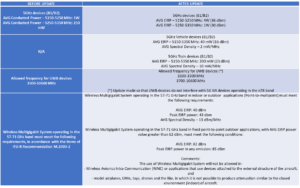
Act 237/2022:
- Revokes Act 6506 (testing method/procedures)
- Inclusion of test procedures for:
- WIFI 6E devices according to FCC KDB 789033 D02 (Reference 3.15);
- Emitter-sensor level detection devices operating in the 76-81 GHz band according to ETSI EN 302 729 V2.1.1 (Reference 3.12) and ETSI EN 302 372 V2.1.1 (Reference 3.13);
- Vehicle Communication System devices according to ETSI EN 302 571 V2.1.1 (Reference 3.11);
- Multigigabit Wireless System, operating in the band 57-71 GHz according to ANSI C63.10 (Reference 3.5);
- LBE and FBE devices (Access sharing system) operating in the bands 5,150-5,350 MHz, 5,470-5,725 MHz, and 5,725-5,850 MHz according to ETSI EN 301 893 V2.1.1 (Reference 3.10).
Below is the official link to Act 423:
Below is the official link to Act 237:
Learn more about Brazil’s general specifications and conformity requirements
Shedding light on the EU Energy Labeling of Light Sources Regulation 2019/2015
February 7, 2022
Since September 2021, a new ecolabel requirement has been implemented in the European Union. It is the Commission Delegated Regulation (EU) 2019/2015 of 11 March 2019 supplementing Regulation (EU) 2017/1369 of the European Parliament and of the Council with regard to energy labeling of light sources and repealing Commission Delegated Regulation (EU) No 874/2012. The short form is EU Energy Labeling of Light Sources Regulation (EU) 2019/2015. In brief, the goal here is to label eco-efficiency scores on lighting equipment.
Why Energy Labeling Lighting Products with Regulation 2019/2015?
First-of-all, in a product’s life-cycle, the use phase can have a great impact on the environment, mainly because of its energy consumption. Indeed, the environmental footprint of energy consumption depends on the electricity source. Coal, oil, or gas sourced electricity is non-renewable and contaminates the atmosphere.
Secondly, lighting equipment is everywhere and represents a considerable opportunity for energy conservation and money savings for consumers!
For these two reasons, informing customers about the product energy rates is paramount.
Importantly, similar comparative energy labels also apply to household appliances like dishwashers, refrigerators, or washing machines.
Products In-Scope of the 2019/2015 – Energy Labeling of Light Sources Regulation
Regulation 2019/2015 has a broad scope. It includes all lighting products and lights integrated into a piece of equipment. For example:
- Desk lamp
- Ceiling light
- Floor lamp
- Ring light, etc.
However, a few exclusions apply.
Products Excluded from EU 2019/2015
For instance, the following lighting devices are out-of-scope, when used in: Aircrafts
- Emergency signs or other related products
- Marine equipment
- Military equipment
- Motor vehicles
- Radiological and nuclear medicine
- Railway vehicles

The following lights are also excluded when they are part of:
- Battery operated products
- Bicycles or non-motorized vehicles
- Electronic displays
- Range hoods
- Spectroscopy or photometric devices

Furthermore, exemptions apply to the in-scope products of the regulation 2019/2015.
The Label Requirements of EU 2019/2015
Eco-Label Information
Due to this regulation, producers must have lighting equipment assessed. Indeed, they must find the correct energy efficiency level from Annex II of EU 2019/2015.
Then, they must present the assessment results to the customers with a label. Such label shows whether the product is energy efficient by displaying a letter ranging from A to G. “A” products are the best of their category, while “G” devices are the least energy efficient.
In addition, labels must bear a QR code. Scanning the product QR code provides more energy-related information.

Template of energy labels to be displayed on lighting products
Source: Regulation (EU) 2019/2015, Annex III
Suppliers Duties about Ecolabels
Distributors or dealers must ensure the adequate communication of the ecolabels and related information to their customers. With this purpose, they may have to:
- Print the labels on the packaging
- Enter the information sheet in the products database and provide other formats if needed
- Enter the technical documentation in a products database
- Display the label on visual advertisements or technical promotion materials
- Provide the electronic versions of the label and product information sheet
- Replace all old labels with new ones
- Display an electronic version of the label and a product information sheet when selling online
- Etc.
The EU 2019/2015 Energy Efficiency Assessment
Energy efficiency assessment is done by a state-designated authority using universal calculations. These calculations consider the declared useful luminous flux and on-mode power consumption, as detailed in Annex II of Regulation 2019/2015.
Is the CE Marking not Sufficient?
The comparative eco-label under Regulation 2019/2015 is different from the CE marking obligations.
 Notwithstanding, Regulation 2019/2020 of 1 October 2019 laying down ecodesign requirements for light sources and separate control gears pursuant to Directive 2009/125/EC is under the CE marking requirements. Regulation 2019/2020 allows European authorities to rule the minimum energy efficiency of lighting appliances placed on the market. In other words, this law leads manufacturers to eco-design more energy-efficient products.
Energy Efficiency Label of Light Sources in the UK
Following Brexit, the United Kingdom has published its Ecodesign for Energy-Related Products and Energy Information (Lighting Products) Regulations 2021. Mainly, their regulations are aligned with the EU Energy Labeling of Light Sources Regulation 2019/2015. Nevertheless, minor differences apply, such as the UK flag on the energy label.

Source: The Ecodesign for Energy-Related Products and Energy Information Regulations 2021, Schedule 7
Generally speaking, one can say that more environmental requirements apply to lighting equipment, including energy labels. Other restrictions apply to substances controlled in these products, like RoHS, REACH-SVHC, TSCA-PBT, or Proposition 65.
Testing Partners is here to help you find the right compliance strategy!
Jordan TRC Regulatory Update
December 15, 2021
Effective Dec 19, all type approval applicants applying for Jordan TRC certification must provide a form that enables the Authority to verify and document the authenticity of the information submitted, including accredited lab test results.
For more information, including a copy of the required form, please contact Testing Partners at (862) 243-2677 or email customerservice@testingpartners.com.
Learn more about Jordan’s general specifications and conformity requirements
Kuwait Regulatory Update
December 13, 2021
The Communication and Information Technology Regulatory Authority (CITRA) of Kuwait announced a new regulation on type approval of telecommunications equipment.
The regulation outlines requirements and conditions for manufacturers of telecommunications equipment wanting access to the market of Kuwait. Thus, it is necessary to apply for approval within national technical standards approved by CITRA to show the compliance with the requirements to radio and telecommunication equipment.
Effective immediately, CITRA will issue type approval certificates for three years, a change from the previous annual approval requirement. This is indicated in Article 11 (Device Type Approval Certificate Validity) clause 1 of the new regulations.
More information on Kuwait regulatory compliance requirements, or for any global type approval requirements, please contact Testing Partners at (862) 243-2677 or email customerservice@testingpartners.com.
Learn more about Kuwait’s general specifications and conformity requirements
JORDAN
November 30, 2021
The Telecommunications Regulation Commission (TRC) of Jordan has published an updated Short Range Device (SRD) License on September, 2021. Updates to the document include changes to the allowances for 5150-5350 MHz, 5470-5725 MHz, and 5925-6425 MHz frequency bands.
For a complete SRD list for Jordan, please contact Testing Partners at (862) 243-2677 or email customerservice@testingpartners.com.
Learn more about Jordan’s general specifications and conformity requirements
Gerber and IFC Free 3-Day Training
November 24, 2021
Gerber and IFC are hosting a free 3-Day training event on #PPE Standards, presented by Testing Partners experts. The training will take place virtually. An email with joining details will be sent as date draws nearer. Save the dates in your calendar! Please click the following link to register
https://gerbertechnology.zoom.us/webinar/register/WN_WTKj2KwBSzG68cpyyTOcPA
Webinar dates:
Nov 29th ,2021 at 1:30 PM IST Duration 2 hours
Nov 30th, 2021 at 1:30 PM IST Duration 2 hours
Dec 1st, 2021, at 1:30 PM IST, Duration 2 hours
What you learn in this webinar:
Day 1 Topics – Nov 29th 2021
US market requirements (product specification, packaging, labeling, etc.) – gowns, masks and surgical drapes
Applicable International Standards for US Regulations – gowns, masks and surgical drapes
US FDA 510k and process to get certification
Requirement for obtaining FDA approval – gowns, masks and surgical drapes
Day 2 Topics – Nov 30th 2021
EU /UK market requirements (product specification, packaging, labeling, etc.) – gowns, masks and surgical drapes
Applicable International Standards for EU & UK Regulations – gowns, masks and surgical drapes
Requirement for obtaining CE marking approval – gowns, masks and surgical drapes
Day 3 Topics – Dec 1st 2021
General requirements for quality management system – medical devices ISO 13485:2016 with focus on real life implementation challenges.
Learn more about USA’s general specifications and conformity requirements
Serbian Ministry of Economy Amends Rulebooks
October 27, 2021
The Serbian Ministry of Economy, sector for quality and safety of products, has issued amendments to the LVD and EMC Rulebooks, effective January 1, 2022.
Below is a summary of the amendments:
Before 01/01/2022
- CoCs issued by Kvalitet in 2021 will remain valid per previous rulebooks
- Products with CoCs dated before 01/01/2022 should have 3A mark on products (where EMC and LVD CoC’s are required), with last two digits of the year of CoC issuance and number of Notified Body.
- No market surveillance
After 01/01/2022
- CoCs will not be mandatory; Kvalitet will issue Certificates (instead of CoCs) confirming the technical documentation with EMC and LVD Rulebooks.
- During the control, Serbian market inspection will take into consideration Kvalitet’s Certificates and the control process will be simpler and faster.
- After 01/01/2022, only the 3A mark will be required (without the last two digits of the year of CoC issuance and number of Notified Body).
- During the control, Serbian market surveillance will be taken into consideration.
Below are the links to the announcements (in Serbian).
https://tehnis.privreda.gov.rs/sw4i/download/files/article/Pravilnik%20LVD-01%20final.pdf?id=15258
https://tehnis.privreda.gov.rs/sw4i/download/files/article/Pravilnik%20EMC-01%20final.pdf?id=15256
For more information on Serbian regulatory compliance requirements or information on any other country approvals, please contact Testing Partners at (862) 243-2677 or email customerservice@testingpartners.com.
Learn more about Serbia’s general specifications and conformity requirements
Rwanda RURA Publishes Changes to Frequency Spectrum
October 25, 2021
The Rwanda Utilities and Regulatory Authority (RURA) has published the use of the unlicensed and light licensed frequency bands, No. 014/R/SM-ICT/RURA/2021.
The purpose of the changes is to ensure the use of the frequency spectrum bands and the broadband service of 2.4GHz, 5GHz and 60GHz. It also addresses fixed outdoor broadband services in the 5GHz and 60GHz frequency spectrum bands.
Any person already conducting activity related to the frequency spectrum bands provided in this regulation have a period of six months from the commencement of this regulation to align activities with the new provisions. For more information about these regulation changes, or info on any global country requirements, please contact Testing Partners at (862) 243-2677 or email customerservice@testingpartners.com.
Below is the link from RURA:
Learn more about Rwanda’s general specifications and conformity requirements
Saudi Arabia Saso Requirements
October 19, 2021
The Saudi Standards, Metrology and Quality Organization (SASO) has released a list of new products that will require a mandatory SASO IECEE/IECEX Recognition Certificate starting November 1, 2021.
Below are the items that required mandatory SASO;
IECEE (Electro-technical Devices and Components)
- Circuit Breakers
- Mobile Phone Charging Cables
- Electric Shavers
- Desktop Computers (PCs)
IECEX (Equipment and Devices Intended for Use in Potentially Explosive Atmospheres)
- Junction Box (Electrical Wire Intersection) with Cable Connection Points
- Control Box with Cable Connection Points
- Gas Detectors and Sensors
- Gas Detection Systems
- Electrical Plugs and Other Connecting Devices
- Electric Pumps
- Linear (Fixed) lighting
For more information about Saudi Arabia compliance requirements, or to confirm whether your product is in scope of IECEE or IECEx, please send a datasheet with the product’s HS code to customerservice@testingpartners.com. For questions about any other country regulations, please don’t hesitate to reach out via email or call (862) 243-2677.
Learn more about Saudi Arabia’s general specifications and conformity requirements
Argentina Regulatory Update
October 14, 2021
ENACOM’s New Electrical Safety Resolution 1038/2021 was published in the Official Gazette on October 7th, 2021, modifying Resolution 169/2018. The new Resolution became effective on Oct. 12.
Summary of changes includes new products added to the list requiring certification, a list of products not authorized for exemption as professional use, changes to surveillance requirements, and changes to certificate extensions.
MAIN CHANGES:
The following products are incorporated in the certification requirement:
- Dichroic or bi-pin lamps.
- Led lamps and modules mounted with led.
- The lamp holders for Dichroic or bi-pin lamps
- Electric fences.
- Hand tools, transportable and garden and lawn machinery, powered by electric motor.
- Manual devices for skin and hair care (razors, grooming equipment, massages, among others)
- Electrical kitchen equipment that performs the functions of heating, cutting, process or liquefy food or beverages.
NEW PRODUCTS ARE ADDED TO THE LIST THAT MUST BE CERTIFIED BY BRAND (SYSTEM 5) AS OF 07/09/2022:
- Emergency lights in all its versions.
- Gas-fired cooking appliances with electrical connections.
- Surface cleaning devices for domestic use using liquids or steam.
- Rice cookers.
- Hot tubs and whirlpool spas.
- Pumps for heating and service water installations.
- Kitchen hoods
- Hot and cold-water dispenser.
- Electric fence energizers.
- Electric fryers for domestic use.
- Portable oven for domestic use.
- Electric juicer for domestic use.
- Household high pressure cleaners and steam cleaners.
- Shavers, hair clippers and the like.
- Electric coffee makers.
- Sewing machines.
- Motor compressors.
- Electric pressure cooker and pots.
- Electric grill, single or double, for domestic outdoor/indoor use
- Electric kettle.
- Sandwich Maker.
- Clothes and towel dryers, portable or fixed.
- Toasters.
- Steamer.
- Waffle maker.
- Yogurt maker
OTHER CHANGES:
- The interlock cords that have mandatory certification by brand are those standardized according to the IEC 60320.
- Electric pans and microwave ovens that have been required to certify by brand are those for domestic use.
- The asynchronous motors that have been required to certify by brand are single-phase.
- A certified “Family of Products” will not be able to incorporate new products without carrying out the Conformity Assessment procedure corresponding to the extended scope.
When the products are commercialized via web, as of 02/09/2022, both the “certificate number” that reaches the product in question and the “Certification Body” that issued it must be indicated in the corresponding publication. This obligation will fall on both the suppliers that use their own sales websites, as well as those owners of portals or websites that serve as intermediaries in the consumer relationship.
CHANGES IN THE EXCEPTIONS – PROFESSIONAL USE:
Annex V: adds a list of products NOT authorized to process the exception for professional use.
Requesting the exception for electrical products for domestic use or for sale to the public is prohibited.
From 02/09/2022 the electrical equipment declared for “professional use” must include in the “local sales document” the legend ” professional use “.
CHANGES IN CERTIFICATE – MARKET SURVEILLANCE:
For products certified through System 4 (Type):
- Maintains surveillance every 12 months.
- Adds an “Identity Verification” every 6 months with samples obtained in the market. Critical components must be corroborated to compare with the list of components of the electrical equipment being monitored.
For products certified through System 5 (Brand):
- Now the surveillance should be done every 12 months (until now it was every 18 months).
- An Identity Verification must be performed.
- If at the time of surveillance, the Certification Body cannot verify a sample in shops or the customer’s deposit, the certificate will be suspended momentarily.
CHANGES IN CERTIFICATE EXTENSIONS:
Brand Certificates (System 5) extended to third parties: surveillance may only be carried out by the certificate holder (the person or company that has an extension should not carry out surveillance), as long as both (certificate holder and extension holder) market the product under the same brand.
For details on the new Resolution and whether your products will be impacted in this market, please contact Testing Partners at 1-833-COMPLY8 or email customerservice@testingpartners.com.
Learn more about Argentina’s general specifications and conformity requirements
Saudi Arabia CITC Updates
October 5, 2021
Saudi Arabia’s CITC recently published an updated document on the “Regulation and Allocation of Commercial Spectrum Bands Identified for the International Mobile Telecommunications (IMT).”
The Communications and Information Technology Commission (CITC) has updated the IMT regulatory document in furtherance of its National Spectrum Strategy, which aims to unlock the potential of radio spectrum in Saudi Arabia by 2025 for a smarter and safer future. The updated regulatory IMT document is part of the implementation plan for CITC’s Spectrum Outlook for Commercial and Innovative Use 2021-2023.
This further strengthens CITC’s strategic transition towards the role of a “Digital Regulator,” and is an expression of CITC’s continuing support for the Kingdom’s transformation into a digital society, with the aim of achieving a global leadership position in the field of radio communications and wireless technologies.
For more information about compliance requirements for Saudi Arabia or any other global country, please contact Testing Partners today at (862) 243-2677 or email customerservice@testingpartners.com.
Learn more about Saudi Arabia’s general specifications and conformity requirements
Malaysia Regulatory Update
October 1, 2021
MCMC has published the new standards for 5G user equipment and base stations:
IMT-2020 (FIFTH GENERATION) – USER EQUIPMENT:
https://www.mcmc.gov.my/skmmgovmy/media/General/pdf/MCMC-MTSFB-TC-T016_2021-IMT2020-5G-UE.pdf
IMT-2020 (FIFTH GENERATION) – BASE STATION:
https://www.mcmc.gov.my/skmmgovmy/media/General/pdf/MCMC-MTSFB-TC-T017_2021-IMT2020-5G-BS.pdf
SIRIM processes are still under discussion and we will keep you abreast of changes.
For more information about Malaysia regulatory compliance and how the regulations impact your devices in this market, or any compliance regulations for global market entry, contact Testing Partners at (862) 243-2677 or email customerservice@testingpartners.com.
Learn more about Malaysia’s general specifications and conformity requirements
Argentina – ENACOM to Enforce Local Testing
September 9, 2021
On September 1, 2021, ENACOM published Resolution 1248/2021 which named the INTI National Lab as an Accredited Test Laboratory to carry out testing and issue reports for the following RF Testing Standards:
- Medical Devices (ENACOM-Q2-60.15 V19.1)
- User Terminals for Mobile Communication Systems (ENACOM-Q2-61.03 V17.1)
- Radio Base Transceivers of Mobile Communication Services (ENACOM-Q2-61.04 V17.1)
This accreditation revokes the use of Declarations of Conformity and enters into force the in-country testing for medical devices and radio base transceivers; whereas for cellular terminals, the local testing would become mandatory only when International certification is not available. This resolution has established an adaptation period of 180 days. Local testing will be applicable starting March 2022.
Type approval affected? Yes
Spectrum: No
Allocation: No
Imports: No
Does it affect label requirements? No
Does it affect user manual requirements? No
What are the bands affected/impacted by this new regulatory update? Cellular bands and Medical bands
Type of technology affected? Cellular, Medical, radio base transceivers
For more information about Argentina regulatory compliance, or for any other global country requirements, please contact Testing Partners at 1-833-COMPLY8 or email customerservice@testingpartners.com.
Learn more about Argentina’s general specifications and conformity requirements
Update to Act 3481
September 8, 2021
In an effort to update Act 3481 – Technical Requirements and Test Procedures for Conformity Assessment of Charger Used In Mobile Phone, ANATEL, the Brazilian certification body, released Public Consultation No. 47 (Annex).
The main proposed changes are:
- Vehicular chargers – ESD testing must be done according to ISO 10605/2008, not IEC 61000-4-2 as before (see item 6.1);
- Mint label for vehicular chargers installed inside the car panel will be voluntary (see item 9.1.1). Accordingly, the use of mint labels in this case is optional and eliminates the need of buying mint labels. Additionally, if the manufacturer decides to not use the mint label, they will need to include the ANATEL ID on the charger label (regular marking). An example of devices that can use this exception is a wireless charger installed in the car panel.At this moment, it is not clear if this exception will apply only to vehicular chargers installed behind the car panel (neither seen nor touched by the user) or to the versions where the user can see, and directly touch, its upper surface.
- ESD (ISO 10605) and Electrical transient (ISO 7637-2) testing applied exclusively for USB type vehicular chargers installed in the car panel or other parts of the vehicle can be done in a 1st part or 2nd part laboratory (see item 10.4).
- Example of device under this scope is USB I/F Box similar to below picture:

This consultation is open for comments until Nov 7th, after which ANATEL will analyze the comments and issue the final document. The publication date of the final version is unknown and will depend on the numbers of contributions. The official document can be accessed using the link below:
https://sistemas.anatel.gov.br/SACP/Contribuicoes/TextoConsulta.asp?CodProcesso=C2514&Tipo=1&Opcao=andamento
For more information about Brazil testing and certification requirements, or regulatory requirements for any country globally, please contact Testing Partners at 1-833-COMPLY8 or email customerservice@testingpartners.com.
Learn more about Brazil’s general specifications and conformity requirements
CHILE SUBTEL
September 1, 2021
The Chilean authority Subsecretaría de Telecomunicaciones (SUBTEL), in order to bring its regulation into line with international standards, announced on July 27, 2021 Resolución 1321 Exenta, updating previous Resolución 1985 Exenta, the fixed technical standard for short range devices in Chile.
The following articles of the regulation were adjusted:
- Article 1, item h)
The frequency band 13553 – 13567 kHz and its corresponding maximum electric field strength 20 mv/m at 30 meters (regarding equipment used for medical applications) were added. - Article 1, item j.1)
17 mw/MHz replaced by 17 dBm/MHz. - Article 1, item j.1)
Devices may operate outdoors, using internal batteries, in the 5925-7125 MHz frequency band with a maximum average EIRP power of 17 dBm. - Article 4
Non-compliance with Resolución 1985 is punishable in accordance with the provisions of Title VII of General Telecommunications Law No. 18.168.
The full resolutions can be seen here:
— Chile Resolución 1985 EXENTA Resolución 1985 EXENTA Resolución 1985 EXENTA
— Chile Resolución 1321 EXENTA Resolución 1321 EXENTA Resolución 1321 EXENTA
Learn more about Chile’s general specifications and conformity requirements
Singapore IMDA Short Range Device Updates
August 23, 2021
The Infocomm Media Development Authority (IMDA) of Singapore released a new version of the IMDA TS SRD on August 2, 2021 (click here for updated version).
The document defines the requirements for Short Range Devices to be authorized to operate in the specific frequency bands open for SRDs.
The update added a Sub-Section for Equipment Safety Testing (4.2.2) as well as a Conformity Assessment Checklist for SRDs (Annex A).
Please refer to Annex B for the specific changes and Annex B1 for the detailed changes in the frequency table (Table 1).
For more information on Singapore requirements for short range devices, or for questions on any global country certification requirements, please contact testing Partners at (862) 243-2677 or email customerservice@testingpartners.com
Learn more about Singapore’s general specifications and conformity requirements
Egypt Regulatory Update
July 30, 2021
Mandatory requirement of Advanced Cargo Identification (ACID) number and other details in Shipment Documents
The Egyptian Ministry of Finance issued Decree 222/2021 for the setting up of an Advanced Cargo Information (ACI) platform, Nafeza, for electronic transmission of shipment data and Customs clearance.
As part of the original enforcement, the Decree mandated that all shipments having a Bill of Lading dated July 1, 2021 and later would need to have the following information clearly indicated on the Certificate of Inspection (CoI) and all other shipment documents: Advanced Cargo Identification (ACID) Number, Importer Tax Number, Exporter’s Commercial Registration Number.
NOTE, however, that the Egyptian Ministry of Finance, via Decree 328/2021, has now postponed the mandatory enforcement date from July 1, 2021 to October 1, 2021.
For more information about Egypt regulatory standards or shipping regulations, or for questions about other global standards, please contact Testing Partners today at (862) 243-2677 or customerservice@testingpartners.com.
Learn more about Egypt’s general specifications and conformity requirements
Singapore Certification
July 29, 2021
Residential Gateways (“RG”) for sale and use in Singapore are subject to compliance with IMDA’s Technical Specification for Security Requirements for Residential Gateway, IMDA TS RG-SEC (“TS RG-SEC”) and equipment registration with IMDA.
The registration of RGs with IMDA will also qualify the RG for CSA’s Cybersecurity Labelling Scheme (“CLS”) Level 1. All new models of RG shall comply with TS RG-SEC, effective April 12, 2021, and all existing RGs that are currently registered under the category of WLAN/SRD that can meet the TS RG-SEC must be re-registered as ‘Residential Gateway’ before October 12, 2021.
Thereafter, the sale of non-compliant and non-registered RGs for local use shall cease and can only be sold for re-export purposes. For more information on this change in regulation for Singapore, or other global certification requirements that may impact your product in these markets, please contact Testing Partners at (862) 243-2677 or email customerservice@testingpartners.com.
Learn more about Singapore’s general specifications and conformity requirements
Legal Representative Required in Europe Before Marketing Products There
June 25, 2021
Effective July 16th, 2021, the Market Surveillance Regulation adopted by the European Commission requires that every business from outside the EU selling products directly or indirectly (through ecommerce platforms) must have either an importer or an authorized representative located in the EU.
The authorized representative will act as a liaison between the manufacturer and a national authority within the EU. The address of this importer or authorized representative must be clearly visible on the product or packaging (or in accompanying documentation, such as the user manual). The purpose of the requirement is to minimize the risk of unsafe products entering the market.
If you don’t have an authorized representative or importer in place by July 16, 2021, customs may not allow your products to enter the EU, or marketplaces such as Amazon won’t allow you to sell your products in the European market. (For more information on Amazon seller requirements, refer to our Amazon compliance tab.)
If you are a non-EU business selling products on the European market when the new Market Surveillance Regulation (EU) 2019/1020 comes into force, stay tuned for our next blog that will cover:
– How to ensure that you can continue selling your products on the European market
– How to determine if the new regulation applies to your products
– What you should do to sell your product in Europe directly, online, or via a fulfillment service provider confidently
– What the effects are for non-UK companies currently selling in the UK market, and the upcoming UKCA authorized representative requirements
– What the rules are for UK businesses selling in the Northern-Irish market
For more information about this blog or other global regulations, please contact Testing Partners at (862) 243-2677 or email customerservice@testingpartners.com.
Learn more about European Union’s general specifications and conformity requirements
New UKCA Mark As It Pertains To Medical Devices
June 2, 2021
The UK Conformity Assessed Mark (UKCA) is the new United Kingdom (UK) product mark that will be used for certain goods being placed on the market in Great Britain (GB – England, Wales and Scotland), following the UK’s exit from the European Union (EU). The UKCA Mark will replace the CE mark completely (see further down for enforcement dates) and covers most goods that previously required CE marking.
SUMMARY OF KEY REQUIREMENTS FOR PLACING A MEDICAL DEVICE ON THE BRITISH MARKET:
Since January 1, 2021, there have been changes introduced by secondary legislation for medical devices placed on the market in Great Britain.
These are:
- CE marking will continue to be recognized in Great Britain until June 30, 2023 for certain devices
- Certificates issued by EU-recognized Notified Bodies will continue to be valid for the Great Britain market until June 30, 2023.
- The EU no longer recognizes UK Notified Bodies
- UK Notified Bodies are not able to issue CE certificates (other than for the purposes of the “CE UKNI” marking, which is valid in Northern Ireland) – and have become UK Approved Bodies.
- A new route to market and product marking is available for manufacturers wishing to place a device on the Great Britain market
- Since January 1, 2021, all medical devices – including in vitro diagnostic medical devices (IVDs) – placed on the Great Britain market need to be registered with the MHRA. The Medicines and Healthcare products Regulatory Agency (MHRA) is an executive agency of the Department of Health and Social Care in the United Kingdom (similar to the FDA in the United States) which is responsible for ensuring that medicines and medical devices work and are acceptably safe. The grace period for registering is as follows:
- Class IIIs and Class IIb implantables, and all active implantable medical devices and IVD List A products, must be registered from May 1, 2021
- Other Class IIb and all Class IIa devices and IVD List B products and Self-Test IVDs must be registered from September 1, 2021
- Class I devices, custom-made devices and general IVDs (that do not currently need to be registered) must be registered from January 1, 2022.
- Manufacturers of Class I devices, custom-made devices and general IVDs that, prior to January 1, 2021, were required to register their devices with the MHRA (i.e. UK-based manufacturers or third country manufacturers with Northern Ireland-based Authorized Representatives) must continue to register their devices from January 1, 2021 on the same basis as they do now, rather than in line with the above dates
- If you are a manufacturer based outside the UK and wish to place a device on the Great Britain market, you need to appoint a single UK Authorized Representative who will take responsibility for the product in Great Britain. Further detail on the UK Authorized Representative is set out below.
LEGISLATION THAT APPLIES IN GREAT BRITAIN:
- Directive 90/385/EEC on active implantable medical devices (EU AIMDD)
- Directive 93/42/EEC on medical devices (EU MDD)
- Directive 98/79/EC on in vitro diagnostic medical devices (EU IVDD)
These directives are given effect in UK law through the Medical Devices Regulations 2002 (SI 2002 No 618, as amended) (UK MDR 2002). These Regulations (in the form in which they existed on January 1, 2021) continue to have effect in Great Britain after the transition period. This means that since January 1, 2021, the Great Britain route to market and UKCA marking requirements are still based on the requirements derived from current EU legislation.
RECOGNITION OF EXISTING CE CERTIFICATES FOR THE MARKET OF GREAT BRITAIN:
Under the UK MDR 2002 (as amended), a CE marked device with a valid declaration of conformity or certificate is viewed as meeting the UKCA mark requirements while the CE marking will be recognized in Great Britain until June 30, 2023. This includes devices placed on the market that are: CE marked in conformance with the EU MDD, EU IVDD or EU AIMDD CE marked in conformance with the EU MDR or EU IVDR. Therefore, any enforcement or market surveillance powers available in respect of the UKCA mark also apply to CE marked devices placed on the Great Britain market. Where certificates have been issued by a UK Notified Body, the Notified Body has been redesignated as a UK Approved Body and will continue to oversee these devices and their manufacturers to ensure continued compliance with the applicable standards of safety and performance under the UKCA mark.
LABELLING REQUIREMENTS:
Medical devices placed on the Great Britain market must have a UKCA mark or a CE mark, depending on which legislation the device has been certified under. Where relevant, the number of the Notified Body or Approved Body must also appear on the label. If you already have a valid CE marking on your device, you are not required to re-label the device with a UKCA mark until July 1, 2023 for placement on the Great Britain market. Devices can have both marks present on the labelling prior to July 1, 2023, and dual marking will continue to be accepted on the Great Britain market after July 1, 2023. However, the name and address of the UK Authorized Representative, where applicable, needs to be included on product labelling where the UKCA mark has been affixed (including when devices have been dual marked).
UKNI MARKING:
UK Notified Bodies can conduct conformity assessments for the purposes of the Northern Ireland market. In addition to the CE marking, device manufacturers also need to apply the UKNI marking if they choose to use a UK Notified Body for mandatory third-party conformity assessment. Device manufacturers must never apply the UKNI marking on its own – it must always accompany a CE marking. To place goods on the EU market, manufacturers must use the CE marking on its own, without the UKNI marking. Goods bearing the “CE & UKNI” marking will not be accepted on the EU market.
In summary, you need to use the UKNI marking if:
- you are placing certain medical devices on the Northern Ireland market; and
- your goods require mandatory third-party conformity assessment; and
- you use a UK Notified Body to carry out those conformity assessments.
The UKNI marking is sometimes referred to as the UK(NI) mark or the UK(NI) indication, including in Article 7(3) of the Northern Ireland Protocol. These terms refer to the same marking.
Most medical devices required EU Notified Body reviews.
- When placing goods on the UK market, in most cases the client will still be able to use the CE mark from January 1, 2021. The CE marking will only be accepted in the UK up until January 1, 2022. Note: The UKCA marking alone cannot be used for goods placed on the Northern Ireland market, which requires the CE mark or CE and UK (NI) mark.
The client can CE mark if any of the following apply:
- Client currently CE marks their existing goods on the basis of self-certification and mandatory third-party conformity assessment was carried out by an EU-27 recognized Notified Body.
- The certificate of conformity previously held by a UK body has been transferred to an EU-27 recognized Notified Body.
- In certain cases, the client will need to apply the new UKCA marking to goods being sold onto the GB market from January 1, 2021 for new products which have not been placed onto the market (new products – new design) with no existing CE certified approval.
Note: The EU does not recognize the UKCA mark (like the EU not recognizing an NRTL mark).
ASSESSMENT ROUTES:
The client will need to demonstrate that their medical device meets the requirements in the UK MDR 2002 by carrying out a conformity assessment. The assessment route depends on the classification of the device.
- General medical devices
- Active implantable medical devices (AIMD)
- In vitro diagnostic medical devices (IVD’s)
COMPLIANCE WITH DESIGNATED STANDARDS:
The client has the option to use any international standard that has been designated to the UK MDR 2002. If the client complies with these designated standards, they will conform with the relevant parts of the directive that are covered by these standards. This includes standards such as ISO 13485 covering quality management systems for medical device manufacturers and ISO 14971 covering risk management for medical devices and other process-specific standards, such as those covering sterilization.
There are also standards which are specific to individual types of medical devices. The use of standards is not mandatory; however, most manufacturers choose to use them.
EXEMPTIONS:
The client should not place a UKCA mark on your medical device if it is:
- A custom-made device – although it must still meet the requirements in the UK MDR 2002 and the type of device should be labelled clearly
- Undergoing a clinical investigation – it must include ‘exclusively for clinical investigation’ and meet the requirements as far as possible – you must take precautions to protect the health and safety of patients • an in vitro diagnostic medical device (IVD) for performance evaluation
- A non-compliant device used in exceptional circumstances (humanitarian grounds)
The client does not need get these checked by a third party to show they conform with the requirements, but they need to draw up a statement to declare their compliance for custom-made devices, clinical investigations and performance evaluation devices.
APPROVED BODY:
A client is required to register with an Approved Body to place product in the UK. An Approved Body is an organization that has been designated by the MHRA to assess whether manufacturers and their medical devices meet the requirements set out in the Medical Device Regulations 2002 (https://www.legislation.gov.uk/uksi/2002/618/contents/made).
Manufacturers can apply to any UK Approved Body, and once they have the necessary certification their products can be sold anywhere in Great Britain (England, Wales and Scotland). Following an appropriate assessment, the Approved Body will issue relevant certification allowing manufacturers to place UKCA marking on their products and place them on the market in Great Britain.
Although the UKCA mark will be available for use in Great Britain from January 1, 2021, CE marking will continue to be needed for devices placed on the Northern Ireland market and EU rules will need to be met. CE marked devices will also be accepted on the Great Britain market until June 30, 2023. From January 1, 2021, to place a CE mark on a medical device for circulation in both Northern Ireland and the EU, manufacturers must use an EU-recognized Notified Body to undertake any mandatory third-party conformity assessment. The results of conformity assessments carried out by UK notified bodies will not be recognized within the EU. Duly designated UK Notified Bodies will be able to conduct conformity assessments for the purposes of the Northern Ireland market alone. For these products, in addition to the CE marking, device manufacturers will also need to apply the UKNI marking. These products cannot circulate on the EU market.
If you have questions about any of the information above, or would like your products reviewed to determine what steps need to be taken to ensure your devices are properly marked in accordance with the regulations as laid out herein, please contact Testing Partners at (862) 243-2677 or email Testing Partners at customerservice@testingpartners.com.
Product Recalls
May 10, 2021
Author:
Jeff Baum
A product recall occurs when a company has sold a product that is deemed defective or a safety hazard and is then responsible for pulling the product off the market and fixing it or removing it altogether, at the cost of the company. Recalls occur for products that could cause serious injury, illness, or death, or those that violate regulatory requirements. When there is global presence, a company’s reputation in the marketplace might be irreparable – although not impossible – to save. The company also typically reimburses affected consumers and can often be part of resulting lawsuits.
Many reputable companies still find themselves victim of product recalls. Using a product consulting expert like Testing Partners can help you double check safety concerns to minimize the risk of recall occurring.
How can a company unknowingly manufacture defective products if they are obtaining the proper regulatory testing and certifications? These days, with manufacturing, building and assembly of one product taking place in numerous factories at various global locations, the same quality assurance practices might not be occurring consistently throughout the supply chain. By the time the finished product makes it to the consumer, it is too late to make changes.
Quality Checks
The larger the company, the more factories are employed to build product, and the more locations are involved in the making of the same product, a higher the number of quality assurance inspections should also be performed, spanning the entire supply chain. Every time a product change occurs, no matter how minor, additional quality checks should be made in order to minimize risk of recall. If manufacturers are not controlling every aspect of the process with direct oversight, there is greater room for supply chain problems such as cost-cutting measures to components and parts, which, as minor as it might seem, makes a difference in quality assurance.
Avoiding Product Recalls
While avoiding product recalls isn’t 100% guaranteed, they can definitely be avoided by establishing manufacturing processes that ensure continued compliance with not only manufacturer specifications, but to regulatory standards requirements.
Performing pre-compliance review at the earliest stages (even during the product design phase) sets a manufacturer up for success. It can save the manufacturer time spent in the lab, money spent on unnecessary tests, and money lost from product recalls resulting from inadequate safety testing. It gives an overview of the regulatory testing standards that will directly apply to the product based on schematics and photos. Following approval of the review, a product construction plan will determine if the product will be capable of passing the required tests based on regulatory requirements and analysis of the product itself. This provides a specific path in the lab that minimizes the risk of test failure. Test failure often occurs because the product wasn’t properly prepared for the required tests.
Whose Responsibility?
The responsibility of product safety and quality assurance typically falls on the manufacturer. However, some countries require the regulatory compliance certificate to be in the name of the local importer, or in the name of an authorized or local representative, and that person is legally responsible for recalls or product safety issues. The manufacturer’s overall reputation in the marketplace could be directly impacted, and any resulting legal battles or fines could be to the detriment of the manufacturer or the importer.
Final Thoughts
Obtaining pre-compliance review, a solid construction plan, testing to the appropriate regulatory standards, global certifications and regular quality assurance checks greatly minimizes the risk of product recall. Skipping important steps in the complete process might get your product to market faster, but increases the risk of product recall.
Contact Testing Partners today to discuss a pre-compliance plan that will set your product, and company, on a path through successful testing and certification. Gain confidence knowing you meet all regulatory requirements for local and global market access. Give your customers confidence in your product and your company. Call 1-833-COMPLY8 or email customerservice@testingpartners.com.
Israel MOC Exempts Products from Type Approval
April 13, 2021
At the beginning of April, Israel’s Ministry of Communication (MoC) released a new list of products that are exempted from type approval in order to encourage the import and competition in Israel’s wireless products market.
The new list of devices according to the ordinance includes:
- Operating within the frequency band 2.4 to 2.4835 GHz in Bluetooth technology according to IEEE 802.15.1 standard, or in ANT / ANT + technology, which include an antenna;
- Designed only for the reception of satellite transmissions for position determination using global positioning such as GPS, GLONASS, GALILEO or BEIDOU system;
- A parabolic antenna with a diameter not exceeding 244 cm including side equipment, intended for the reception of satellite broadcasts;
- Devices operating in the field of infrared frequencies between 1,000 GHz and 3,000 GHz with a transmission not exceeding 200 mW;
- Computer peripherals (mouse, keyboard);
- Computer monitors;
- Video Streamers (compliant with the provisions of the European Radio Equipment Directive 2014/53/EU and labelled with CE marking);
- E-book readers (without cellular functions);
- Tablets (without cellular functions);
- Laptops (without cellular function);
- Desktop computers (without cellular functions);
- Converters for the reception of television broadcasts to the public and TV receiver set-top boxes (devices need to be in accordance with the European Radio Equipment Directive 2014/53/EU and bear the CE marking);
- TV Sets;
- A radio receiver for the reception of public broadcasts using FM / DAB / AM technologies;
- Spare parts for a mobile phone;
- Wristwatch, excluding mobile wristwatch;
- Vacuum cleaners;
- Portable battery-operated metal detectors.
PLEASE NOTE: Although this list has been signed by the Ministry of Communications, the free import order has not yet been updated so there is a gap between what is required by MOC and what is being allowed through Customs. Therefore, the Ministry of Communications is still issuing normal telecommunications certificates on the products in the list above until further notice.
For information on how this impacts your device in the Israel market, or certification support for any country globally, please contact Testing Partners at 1-833-COMPLY8 or email customerservice@testingpartners.com.
Learn more about Israel’s general specifications and conformity requirements
Brazil Certification Renewals
April 2, 2021
Friday, May 7, ANATEL published Official Letter No. 65/2021. In summary, due to the continued impacts of COVID-19, ANATEL is extending the streamlined renewal process. For now, all type approval certificates with expiration dates between March 6th, 2020 – Dec 31st, 2021 are exempt from conducting renewal testing and providing new internal/external photos as long as the device has not been modified in any way.
For assistance with Brazil certifications, or any questions about global certifications or pre-compliance mapping, please contact Testing Partners at 1-833-COMPLY8 or email customerservice@testingpartners.com.
Learn more about Brazil’s general specifications and conformity requirements
Transition period for ISED’s ISM Equipment Standard ends in July
March 23, 2021
Canada’s Department of ISED (Innovation, Science and Economic Development) published last year the Interference-Causing Equipment Standard, ICES-001, issue 5, Industrial, Scientific and Medical (ISM) Equipment, which sets out the minimum requirements applicable to industrial, scientific and medical (ISM) equipment, including limits for and methods of measurement of radiated and conducted radiofrequency emissions produced by ISM equipment, as well as administrative requirements applicable to such equipment.
The transition period will end in July 2021, one year after the publication of the standard, for which compliance with either issue 4 or issue 5 of ICES-001 will be accepted. After the transition period, all products subject to this standard that continue to be manufactured, imported, distributed, leased, offered for sale, or sold in Canada shall comply with issue 5 of ICES-001.
The draft ICES-001 Issue 5 has been revised based on comments received. The updates with changes shown in the document include:
- Extension of the transition period from 6 months to 1 year.
- Clarification that ICES-Gen takes precedence over the normative references (such as CSA CISPR 11:19).
- Clarification that induction cooking appliances are Class B (this clarification is needed for the purpose of labeling but does not affect the existing limits applicable to these appliances).
- Addition of requirements for operating induction cooking appliances during the test (by referring to Annex A of CISPR 14-1 Ed. 6).
- Addition of new Annex B with deviations from the LLAS validation requirements specified in CISPR 16-1-4: a more relaxed tolerance allowed for the LLAS validation (±3dB, instead of ±2dB) and tabulated values of the reference validation factor. This is consistent with amendment 1 to CISPR 16-1-4 Ed.4.0.
For more information about the requirements of Canada’s ISM Standard, or for information on regulatory compliance requirements for any country globally, please contact Testing Partners at 1-833-COMPLY8 or email customerservice@testingpartners.com.
Learn more about Canada’s general specifications and conformity requirements
Update To Previous Notification Re: Saudi Product Safety Program
March 16, 2021
Effective July 1, 2021, the following new products will be added to the list that requires the SASO IECEE Recognition Certificate.
- Electrical pumps (5HP and below)
- Coffee makers and Coffee making machines
- Electric Fryers
- Electrical Cables
- Video games and accessories
- Electric water kettles
For verification of whether your products fall into these requirements, and for additional technical support for Saudi Arabia or any countries globally, please contact Testing Partners at 1-833-COMPLY8 or email customerservice@testingpartners.com.
Learn more about Saudi Arabia’s general specifications and conformity requirements
Mexico Revises Conformity Assessment Regulations
February 25, 2021
A New Mexico conformity assessment procedure was entered into force on February 25, 2021, establishing procedures, periods and schemes to carry out the certification and evaluation of the conformity of a product, equipment, device, apparatus or infrastructure intended for telecommunications. Some of the changes, such as the inability for third party certificate holders to hold approvals, will affect both products subject to local testing as well as those handled by a “perito” but this has not been officially confirmed by IFETEL. The following is a summary of the expected changes for Radio/Telecom conformity to applicable PEC processes where there is testing to specific Mexican NOMS:
Schemes – 4 approval schemes will be available:
- Single Batch: a set of new products, equipment, devices or appliances of the same model and brand. This certification scheme is for products that are imported in a single batch on a single occasion; the certificate cannot be extended and the applicant must provide a list with the serial number of each product contained in the batch to send to the “Secretaria de Economía.” 2 samples are required for testing.
- Multiple Batch: More than one batch of products of the same brand and model. Products must be new. In this scheme, only the numbers of batches (not model numbers) can be increased in subsequent filings and the total number of products per batch will be required. This information will be sent to the “Secretaría de Economía.” 2 samples are required for testing. Surveillance must be done at the warehouse or sales outlet of the approval holder.
- Family: This scheme applies to products from the same brand that retain the same technical design characteristics. The standard indicates that the differences in the model numbers is limited to aesthetics and appearance but the interpretation of this by certification bodies has not been tested. In this scheme, an unlimited number of models may be certified. The requested models will be listed on the certificate, and models may be added once it has been defined that the new models are part of the family. For this, the family must first be carried out and then obtain the certificate. 4 samples will be required, that is, two pairs of different models representative of the family. Surveillance must be done at the warehouse or sales outlet of the approval holder.
- Device (may be a module): The certificate of this scheme will be issued to the device and the initial certificate will indicate one product in which the device is incorporated. It requires 2 samples. It is possible to extend the certificate to include additional models where the device will be installed. Surveillance will take place in the warehouses and points of sale of the approval holder. Condition for this scheme: Different trade names, same brand, different models, and all models that use the device.
- The Certification Body will carry out the logistics of receiving and sending the sample to the laboratory.
- The validity of the test report will be 60 business days from when it was issued.
- The Certificate of Conformity will be canceled if within the first 5 days if the homologation request has not been delivered to IFT to complete the application for homologation. The suspension of the Certificates of Conformity will be made known to the IFT, PROFECO and the Secretaria de Economía for the OC, for the relevant purposes, within a period of more than 2 days from the declaration of the suspension.
- The Certificate of Conformity, the test report and / or the official opinion issued by the certification body are non- transferable, so they will only be valid with respect to their holder. Affiliates (legally correlated companies) are allowed to make use of the certificate of conformity after meeting a series of requirements of annex A which is part of the new procedure. However, third party organizations may not leverage the CoC or test report.
- Only NEW products can be certified under any of the approval schemes. Used equipment will not be eligible for homologation.
- First Surveillance will take place in 2022. Only 5% to 15% of the current certificates will be selected for the multiple batch and family certificates. For Device certificates, 50% will be selected and for device certificates that include multiple models, 1/3 of listed products must be tested.
- The certificates issued before the new procedure enters into force remain valid in the terms in which they were issued (subject to Surveillance).
- The location at which surveillance will be made must be established at the time of certification as it will appear on the Certificates.
For questions about any of the regulation changes above, or information on how to get your device(s) properly certified for access into the Mexico market, or any other global market, please contact Testing Partners at 1-833-COMPLY8 or email customerservice@testingpartners.com.
Learn more about Mexico’s general specifications and conformity requirements
Qatar CRA Updates Class License for SRD
February 25, 2021
Current developments in technology required Qatar’s certification authority, Communications Regulatory Authority, to update Version 3 of the Class License for Short Range Devices. This document specifies the harmonized standards to be used for Short Range Devices. The upcoming Version 4 is intended to cover additional applications of radio-communication devices. Public input will be welcomed by CRA via email until March 11, 2021.
A copy of the CRA document in English can be found here:
https://www.cra.gov.qa/en/document/public-consultation—updated-class-license-for-srds
For details on Qatar and other global regulatory requirements, or full compliance mapping review, please call Testing Partners at 1-833-COMPLY8 or email customerservice@testingpartners.com.
Learn more about Qatar’s general specifications and conformity requirements
Egypt NRTA New SRD Radio Spectrum Guidelines
February 9, 2021
In case you missed it, Egypt NTRA issued new SRD Radio Spectrum Guidelines back in December 2020. The guidelines provide the regulatory provisions and technical limitations for using short-range device equipment including: frequency ranges, maximum permissible power levels, channel spacing or modulation/maximum occupied bandwidth and duty cycle. The regulation is issued in accordance with Egypt telecommunication law No. 10 of 2003.
Companies operating under the state’s jurisdiction that wish to manufacture or import wireless devices that are classified under the category of short-range devices for the purpose of selling in the Egyptian market shall submit requests to register the items of these equipment types with the NTRA after completing all the necessary applications prior to their manufacturing or importing the devices. They must also submit the technical specification certificates from the country of origin and certificates of passing technical compliance tests from accredited laboratories.
In the case that an operator of any wireless device classified under the category of short-range devices (SRD) violates the provisions of these regulations, the approval granted to him/her in Article 5.1 of these regulations is cancelled and void temporarily until the cause of the violation ceases to exist.
For the details within the revised guidelines for Egypt market access, click here:
https://www.tra.gov.eg/wp-content/uploads/2020/12/Guidelines-for-using-short-range-devices-srd-in-egypt.pdf. For information on the regulatory requirements for any other country globally, contact Testing Partners at 1-833-COMPLY8 or email customerservice@testingpartners.com.
Learn more about Egypt’s general specifications and conformity requirements
CE – RED Directive
February 4, 2021
Effective August 6, 2021, products with wideband transmission systems transmitting in the 2400 MHz to 2483.5 MHz range will be required to comply with EN 300 328 Version 2.2.2, which will provide a presumption of conformity with the Radio Equipment Directive.
If your current test reports cite an earlier version of the standard (earlier than V2.2.2), then you will most likely require additional testing to bring your product compliance reports up to date. Testing Partners can perform a gap analysis of your existing reports and confirm which specific tests, if any, may need to be performed.
Contact our team to discuss full global mapping to determine how best to leverage existing test reports for full global compliance certification. 1-833-COMPLY8
Learn more about European Union’s general specifications and conformity requirements
BRAZIL ANATEL – New Cyber Security Requirements for Telecommunications Equipment
January 28, 2021
On January 5, 2021, Brazil’s certification body, ANATEL, published Act 77, approving new Cyber Security Requirements for Telecommunications Equipment. This new Act will become in force 180 days after its publication.
In summary, the Act discusses the following:
- The Act is applicable to all terminal devices with connection to internet and telecommunications network infrastructure equipment.
- According to item 4.1, when requesting the approval of devices under the scope of this Act, ANATEL will request a Declaration Letter from the applicant with the following content:
- Indication that the product was developed in compliance with the principle of security by design
- Proof that the equipment and its supplier meet the requirements of the Act
- Recognition that they are aware that cybersecurity requirements are subject to updates, including regulatory and administrative, in line with technological development, with the emergence of new threats or vulnerabilities.
- According to item 4.2, when ANATEL implements the Market Surveillance program, they can assess whether the product and its supplier maintain compliance with the requirements of this Act. At this time, there is no Market Surveillance procedure in force
- Items 5 and 6 of Act 77 describe the specific requirements for Cyber Security, such as software/firmware updates; remote management; installation and operation; access to device configuration; and personal data.
For a copy of the English version of this Act for your records, or a consultation on how this will impact your devices in the Brazilian market, please contact Testing Partners at 1-833-COMPLY8 or email customerservice@testingpartners.com.
Learn more about Brazil’s general specifications and conformity requirements
Big Changes to Sri Lanka’s Type Approval Process
January 6, 2021
The Telecommunications Regulatory Commission of Sri Lanka (TRCSL) has made amendments to the Radio and Telecommunications Terminal Equipment (RTTE) Type Approval Rules under Section 68, Sections 5(o), 5(q), 5 (v)& 5 (w) of the Sri Lanka Telecommunications Act No: 25 of 1991.
The RTTE Type Approval Rules came into effect on December 16, 2020 and will impact new devices, as well as previously-certified devices, going into this market. Below is a summary of the type approval changes:
1. One (1) sample will be required to support type approval applications, with TRC reserving the right to request up to two (2) samples for all type approvals (previously only telecom products needed samples).
2.There will be mandatory labelling requirements for all equipment approved by TRC. Labels must be purchased from TRCSL and permanently affixed on the approved products.
3.The processing period of an application for type approval under the Standard Type Approval process takes up to thirty (30) working days from the date on which the complete application package has been submitted to the Commission.
4. Certain categories of RTTE products are exempt from type approval provided that products meet the relevant technical specifications as per regulation.
5. Applicants should submit test results only from accredited test laboratories recognized by the Commission for Type Approval. The date of the test report shall not be older than three (3) months at the date of application.
6. Existing certificates obtained before December 16, 2020 will remain valid for six (6) months; pursuant to new rules, a simplified application process can be used in this case.
7. Validity of certificate changes from three (3) years to four (4) years .
These changes impact all types of products, regardless of whether the certificate still has ample time left on the current certificate obtained prior to December 16, 2020. Applicants are required to follow these new requirements immediately.
For clarity on ANY of the above points, to see if your products are part of the approved exemption list, or for a full compliance review of your devices to ensure adherence to these regulations for any global market, please contact Testing Partners immediately at customerservice@testingpartners.com or call 1-833-COMPLY8
Learn more about Sri Lanka’s general specifications and conformity requirements
Syria Regulatory Update
December 30, 2020
The Syrian Telecommunications & Post Regulatory Authority has started to request Safety Test Reports according to EN 62368-1, effective December 20, 2020 onwards, when type approval is requested.
They will no longer accept EN 60950 reports. Previously approved devices are not affected by this requirement.
For specifics on the Syria type approval requirements and application process, or any other standards and regulations for global market access, please contact Testing Partners at 1-833-COMPLY8 or email customerservice@testingpartners.com.
Learn more about Syria’s general specifications and conformity requirements
Brazil Regulation Update on Renewal Testing
December 22, 2020
This week, ANATEL published Official Letter 646/2020. Due to the continued impact of COVID-19, ANATEL has decided to extend the renewal process defined in Letters 134/20, 194/20 and 384/20. Now, all certificates with expiration dates between March 6th, 2020 and June 30th, 2021 are exempt from doing renewal testing and providing new external/internal photos providing there are no changes to the product. For copies of the letters please contact our team.
If you have any questions about this regulation change or would like a quote on initial certification or renewal in Brazil or any global market, please contact Testing Partners at 1-833-COMPLY8 or email customerservice@testingpartners.com.
Learn more about Brazil’s general specifications and conformity requirements
Brazil – ANATEL Proposed Regulation
December 10, 2020
Brazil’s certification authority, ANATEL, published new Act 7280 last week. This act approves the updating of the Reference List of Products for Telecommunications and replaces Act 2222 of April 20th, 2020. This new Act will become in force 180 days after publication (in force after June 1st, 2021).
The main changes will make a huge impact in certification requirements for several types of devices, and are summarized below:
One of the biggest changes should make manufacturers very happy: All products that previously required renewal every one year, will now require renewal every two years. Products included in this category are ONTs, WWAN devices, mobile phones, batteries and chargers for mobile phones, IP phones, and many others. There will be no more annual renewal.
ANATEL will require ISO Certificate (with sworn-in translation, if in English) for all certifications, except for those products whose Conformity Assessment Mode is “Conformity Declaration.”
ANATEL will accept test reports done abroad for some devices, such as OLT, Data Network Equipment (Switch) installed in professional/industrial environment, digital multiplex, and many others. The foreign laboratory must also be ILAC-accredited.
It’s not all good news, however. Some types of products previously not requiring any renewal, will now require renewal every three years. Products included in this category are OLT, Data Network Equipment (Switch) installed in professional/industrial environment, multiplexer, coaxial cables, some types of optical cables, and many others.
For more information about Brazil’s compliance certification regulations, or if you have questions about any global certification requirements, please contact Testing Partners at 1-833-COMPLY8 or email customerservice@testingpartners.com.
Learn more about Canada’s general specifications and conformity requirements
Amazon ASIN
August 13, 2020
Author:
Jeff Baum
AMAZON ASIN SUPPRESSION AND SAFETY COMPLAINTS
What should you do when your Amazon ASIN is suppressed due to a safety complaint, customer complaint, or for violating the Amazon Sellers Agreement?
Submit all relevant safety testing data and certification for the item.
Include testing specifically related to the incident in question. PLEASE NOTE: An MSDS does not suffice for safety testing. You may need to reach out to the manufacturer of the product for the details you might not have.
If you have questions about the appropriate standards for the product, please contact Testing Partners directly.
Review your records: is this a known issue/complaint? If so, what actions have you taken to resolve the root cause of the issue in order to prevent future incidents?
Always ask for the product to be returned back to you to investigate or at least have photos provided from customer or complainant.
What corrective actions are you planning to implement after you became aware of this incident/concern? What is the time frame for them to be implemented to your internal process?
Do you have a Product Safety or Product Quality Control system in place to identify potential product safety issues?
To your knowledge, have any design changes been done to the product recently? If so, when was the product modified and what changes were implemented?
Has the product been part of a recall?
Provide images of the product (front, back, accessories, and packaging). Images should include: model/serial number; safety/compliance marks; logos and safety labels; warnings on the product or packaging.
Provide a copy of the instruction manual.
If you are unsure of where to begin to ensure you meet all Amazon seller requirements, please contact Testing Partners at 1-833-COMPLY8 or customerservice@testingpartners.com.
Selling on Amazon: Part 2
August 7, 2020
Author:
Jeff Baum
In addition to the information on our previous blog about Amazon Product Compliance (if you missed it, you can find it here: https://testingpartners.com/navigating-the-challenges-of-amazon-product-compliance/), Amazon may choose to review certificates and test reports for products sold on Amazon.com or any other Amazon-affiliated website. As a vendor or seller, it is your job, not Amazon’s, to review and understand the requirements before making any submissions. Any products marketed or sold on Amazon.com or any other Amazon-affiliated website must comply with all applicable laws, mandatory standards, and Amazon policies.
Electronic Safety Certification
Do you know the requirements to show evidence of electronic safety certification? For example, certification with the name of the certifying agency and file number should be included, to start. The submitted product must be represented by a unique model number and should match the model number listed in the certification. You are not required to be UL or equivalently approved; this certification must be completed by an ILAC MRA- approved ISO 17025 certified testing laboratory, not specifically a Nationally Recognized Testing Laboratory (NRTL).
Third Party Testing
Did you know that independent 3rd party testing at specific accredited laboratories is required for all children’s safety-regulated products? For many children’s products (such as toys and apparel), you must also be able to furnish a Children’s Product Certificate for the product and meet the applicable CPSC Regulations. If you are unsure if your local lab is accredited for children’s product safety certification, contact Testing Partners.
Did you know that Amazon accepts only passing test reports for products tested from a production run? Testing completed on pre-production or prototype products will not be accepted.
But Wait…There’s More!
In addition to random compliance checks, and adherence to laws associated with banned or recalled items, Amazon reserves the right to request additional compliance documents and other information for your products. The submission of test documentation alone does not guarantee approval for your products to be listed on Amazon.com or any other Amazon affiliated website.
Clearly, simply deciding to sell your products on Amazon and its affiliated websites is not enough. The risks of not complying with Amazon compliance regulations could be costly in both time and money, impacting your time to market, your competitiveness in the marketplace and disappointed buyers. Let Testing Partners review your product to make sure you meet Amazon Compliance Guidelines and save yourself from the hassle of scrambling after product is in the market or having your ASIN suppressed. For any questions, or additional information, about any of the topics above, please contact us at 1-833-COMPLY8 or email customerservice@testingpartners.com.
Risks of Global Noncompliance
July 22, 2020
Many manufacturers choose not to obtain required wireless or safety certifications for their devices going into global markets for various reasons. While those reasons might seem valid, and are definitely based on value, the risks of noncompliance can far outweigh the few thousand dollars certification costs for global markets. Have you ever stated any of the following comments? “We don’t ship enough product into that region.” “Our sales revenue doesn’t offset the cost of certification.” “We’ve been shipping into that country for years without certification.” “They don’t check at Customs.” While we agree that sales revenue is top priority in manufacturing processes (or what’s the point, right?), thinking long-term plays a huge role in your overall success and teaches your entire team the benefits of being proactive instead of reactive.
More countries are cracking down at customs and could change tomorrow. The international regulations for type approval and safety certifications were put into place for each country with varying caveats. Some were written as a way to enforce use of the radio spectrum, and sets forth boundaries and allowances within the scope of the regulation. The purpose of a regulation in one country might stipulate that the regulation is in effect strictly to dictate which bands are allowed to be used by non-governmental entities, for example. A manufacturer can go a lifetime without violating the radio frequency usage laws, and technically, be compliant with the law as it pertains to which bands can be used. However, the fact that a country has a regulation for using the bands isn’t the end of the regulation: the regulation is actually stating certification must be obtained proving they are not violating the usage of any bands. If certification is not obtained, and the manufacturer has products utilizing the radio frequency spectrum in accordance with the regulation, and the authority decides to start checking for certification, the manufacturer will be held accountable for violation of not holding certification.
Some countries do check at customs, and the regulations are written in a way that dictates this. However, other countries don’t detail the customs enforcement in writing, so when manufacturers come to us asking for proof within the regulations for each country, the detailed specific proof might not be available. It is proof enough, however, that a regulation for certification exists, based on the technology within the products. It has to be assumed, therefore, that because the regulation for certification exists, there will be risks involved if certification is not obtained, and this is a gamble manufacturers must decide if they want to take. Rolling the dice on obtaining certification could be the difference of a $1500 permanent certificate or tens of thousands of dollars in returned product, customs shipment holds, product pulled from shelves, etc, all at the cost of the manufacturer. Spending a few thousand dollars for peace of mind knowing you are continually compliant with certification regulations over noncompliance is one less aspect of your daily life you need to worry about.
If the stress of not knowing each country’s constantly changing regulations keeps you from obtaining the necessary certifications, or you don’t know how to build a product that will be compliant with global regulations, that’s the time to pick up the phone and call Testing Partners. You don’t need to pay an employee $60K annually to work on certifications. Let us handle that for you so you can focus on other aspects of your job, like sales or new product launches. We can help you create, engineer, build and certify every product from start to finish, for anywhere in the world you want to ship your product (within government allowances, of course).
Do you want to be the one caught without certification? The risks of noncompliance could cost way more than certification. Testing Partners can map out the risks so you can determine which countries are priorities based on cost, certification validity, and more. Give us a call!
#testingpartners #globalcompliance #gma #globalmarketaccess #international #certification #precompliancereview
#testing #typeapproval #certification #regulations #standards #regulatory #cbreport #ce #eaeu #fcc #fda #rohs
#reach #emi #electromagnetic #sensors #wireless #safety #electrical #appliances #medicaldevices #safetyreport
#nomsafety #nom #mexico #brazil #enacom #argentina #anatel #smark #africa #southafrica #srrc #china #india
Commercial Displays: Transition to UL 970
July 9, 2020
ANSI/UL 970 for Retail Fixtures and Merchandise Displays is a new standard that combines two previous standards to offer a streamlined path for safety evaluation. All products must comply with this new standard by February 20, 2022.
This new standard combines requirements from ANSI/UL 65 (Wired Cabinets) and ANSI/UL 962 (Household and Commercial Furnishings). ANSI/UL 970 includes new and updated requirements for commercial displays, showcases, and temporary displays including those incorporating lighting, motors, and sensors.
Contact Testing Partners to support you with this transition.
Learn more about USA’s general specifications and conformity requirements
Mexico – Upcoming NOM-001-SCFI-2018
July 6, 2020
Testing Partners received notification that NOM-001-SCFI-2018, Electronic Devices – Safety Requirements and Test Methods (which cancels NOM-001- SCFI-1993) will be postponed until August 14, 2020 (previously expected to go into effect this past May 2020).
In summary, the new NOM-001-SCFI-2018 will note the following changes:
Issuance of a test report will take longer. Lead times will vary based on testing requirements associated with the type of product.
Devices that didn’t require testing for NOM safety before might require testing and certification under this new NOM.
The HS code will be analyzed to determine the number of tests required. Samples will be tested under each requirement.
Samples will be destroyed under new testing procedures and multiple samples might be requested.
Learn more about Mexico’s general specifications and conformity requirements
Qatar Publishes Class License for Use of RLAN Devices
June 10, 2020
The Communications Regulatory Authority State of Qatar (CRA) released class license for the use of RLAN devices operating in 5925-7125 MHz band Wi-Fi 6 at the end of March 2021.
This document was established to stay up-to-date with evolving technology as now the Wi-Fi 6 becomes a part of daily life. According to this document, the CRA recommends allocating the entire 5925-7125 MHz band for the indoor and outdoor use by RLAN devices with the following limitations:
- Low-power: max e.i.r.p. of 24 dBm and PSD of 5 dBm/MHz (indoor use only)
- Very low-power: max e.i.r.p. of 14 dBm and PSD of -8 dBm/MHz (portable use both for indoor and outdoor).
The Wi-Fi 6 devices must be type-approved by the CRA in accordance with the Type Approval Policy for R&TTE to be imported and sold on the market of Qatar. As per the Class License for the use of RLAN devices over 5925-7125 MHz band Wi-Fi 6, a company should be registered in the CRA and have import authorization for R&TTE.
The document will become effective when the CRA reviews all proposals and takes the relevant amendments.
For information on certification requirements for Qatar or other global markets, please contact Testing Partners at (862) 243-2677 or email customerservice@testingpartners.com.
Learn more about Qatar’s general specifications and conformity requirements
MiC Vietnam Changes in the certification procedure
May 21, 2020
MiC Vietnam approval has officially released Circular 10/2020/TT-BTTTT amending and supplementing Circular 30/2011/TT-BTTTT (together with Circular 15/2018/TT-BTTTT). The new Circular shall enter in force since July 01, 2020.
Summary of Circular 10/2020/TT-BTTTT:
1. MiC Vietnam approval shall grant a type approval certificate for oversea manufacturers directly. ( previously only can be hold by local Importer, now by oversea manufacturer hold the cert they can authorize multiple importers)
2. Oversea manufacturers are allowed to sign a self-assessment declaration of conformity which is needed for the “Product Quality Inspection Registration” (PQIR)process which is a part of the customs clearance process. In such case, Self-assessment DoC must be based on the test report which oversea manufacturer is “test applicant” (test report holder).
3. In order to use “Type Approval certificate” and “Self-assessment DoC” granted under name of oversea manufacturer(s), local importer shall need to submit a “notification on list of product models and importers allowed” to VNTA during PQIR process.
4. Conformity certification organizations can be VNTA or any other certification bodies which are designated by MIC Vietnam for certification activities.
5. New certification systems (methods) has been officially introduced, which now includes three methods: ( previously only Type approval system Which is type 1B , now they only accept as below)
Certification system 1: Certification based on typical sample testing, applicable for products manufactured by ISO 9001 certified factory(ies). Certificate granted under this system shall be valid for maximum 03 years.
Certification system 5: Certification based on typical sample testing combined with factory inspection applicable for products manufactured by a factory that has not obtain ISO 9001 certificate yet. Certificate granted under this system shall be valid for a maximum 03 years but factory audit shall be required anually to maintain certificate validity.
Certification system 7: Consignment approval (per-lot approval), applicable when system 1 or system 5 are not applicable. Certificate granted under this system shall be valid for a single import lot / consigment only.
6. Type Approval Certificate or Letter of Acceptance of Declaration of Conformity granted before the enforcement date of this circular shall keep its validity.
Learn more about Vietnam’s general specifications and conformity requirements
Withdrawal of the UK and EU rulead in the field of chemicals regulation under Reach
May 21, 2020
Since 1 February 2020, the United Kingdom has withdrawn from the European Union and has become a ‘third country’ following Brexit. The Withdrawal Agreement2
provides for a transition period ending on 31 December 2020.3 Until that date, EU law in its entirety applies to and in the United Kingdom.
During the transition period of Brexit, the EU and the United Kingdom will negotiate an agreement on a new partnership, providing notably for a free trade area. However, it is not certain whether such an agreement will enter into force at the end of the transition period. In any event, such an agreement would create a relationship which in terms of market access conditions will be very different from the United Kingdom’s participation in the internal market, in the EU Customs Union, and in the VAT and excise duty area.
As of the end of the transition period, Regulation (EC) No 1907/2006 of the European Parliament and of the Council of 18 December 2006 concerning the Registration, Evaluation, Authorisation, and restriction of Chemicals (REACH) and establishing a European Chemicals Agency no longer applies in the United Kingdom. This has in particular the following consequences for example.
Registrations held by a registrant (manufacturer/producer, importer or Only Representative) established in the United Kingdom According to Article 5 of Regulation (EC) No 1907/2006, as a general rule, substances on their own, in mixtures or in articles manufactured or placed on the EU market in quantities of 1 tonne or more per year have to be registered with the European Chemicals Agency (ECHA).
As of the end of the transition period, a registration held by a registrant (manufacturer/producer, importer or Only Representative) established in the UK is no longer valid in the EU.
Manufacturers/formulators/producers established in the United Kingdom should:
-Transfer the registration to a manufacturer or importer in the EU; or
-Appoint an Only Representative in the EU as a registrant for the substance.
You can see the full documnet here.
Learn more about European Union’s general specifications and conformity requirements
USA has published FCC 19-126 for RF exposure
May 21, 2020
The FCC certificate published the rule related to the methods that may be used for determining and achieving compliance on human exposure to radiofrequency (RF) electromagnetic fields. It amends the rules related to an increasingly important part of demonstrating and maintaining RF exposure compliance.
Main points which published by FCC certificate are as follows:
- The amended rules are intended to provide more efficient, practical, and consistent RF exposure evaluation procedures and mitigation measures to help ensure compliance with the existing RF exposure limits.
- The amended rules replace the various inconsistent service-specific criteria for exempting parties from performing an evaluation to demonstrate compliance with the RF exposure limits with new, streamlined criteria.
- The amended rules allow the use of any valid computational method to determine potential RF exposure levels, remove the minimum evaluation distance requirement for frequencies above 6 GHz, and establish post-evaluation RF exposure mitigation procedures.The effective date is June 1, 2020.
Learn more about USA’s general specifications and conformity requirements
ANATEL Resolution nº 726 (2020) become in force after Sep 1st
May 21, 2020
ANATEL type approval released new Resolution 726 (May 5th 2020). This resolution will become in force after Sep 1st and it replaces the restricted bands defined in the Table I of Res. 680/2017. The main change is related to the WI-FI 6E frequency range (5.9 GHz to 7.1 GHz) forbidden in Brazil before.
Also, this new resolution of ANATEL type approval allows using the range of 5.850–5.925 GHz for 802.11p (V2X), 57 to 71 GHz for 802.11ad and 76 to 81 GHz for radar systems.
Learn more about Brazil’s general specifications and conformity requirements
Turkey introduced a new regulation on product safety
May 21, 2020
The Ministry of Commerce in Turkey introduced the new product safety regulation which covering all products intended to be placed on the market, offered or put into service. The law introduces obligations and provides notice and take-down/access ban procedures regarding sales and promotion of products that do not comply with product safety requirements for Turkey type approval.
The obligations of certain commercial operators as per the product safety for Turkey type approval Law are designated as follows:
| Action to take | Manufacturers | Importers | Authorized Representatives | Distributors |
|---|---|---|---|---|
| Keep the copies of the documents which show the compliance of the products at least for ten (10) years | √ | √ | √ | |
| Enforce the instructions of the authorities for product safety and conduct official registrations, if required. | √ | √ | √ | |
| Present products which comply with technical regulations or general product security legislation indicated under the Product Safety Law | √ | √ | ||
| Take required measures for potential risks and inform end-users to prevent the risks | √ | √ | ||
| Ensure that the information provided with the products is in the Turkish language | √ | √ | ||
| Test and examine the product risks with samples | √ | √ | ||
| Cease the presentation of the products from the market or recall if the products are not compliant | √ | √ | ||
| Enforce the instructions of the authorities for product safety and conduct official registrations, if required | √ | √ | ||
| Provide technical file, conduct compliance examination, if required, and compliance symbols, statements, and documents | √ | |||
| Provide information on model, party, a serial number of the product and information on its trade name, trademark, and address in the documents presented with the product | √ | |||
| Ensure that the product is presented with the required compliance symbols and documents, and the manufacturer fulfilled its obligations regarding the information to be provided with the product | √ | |||
| Provide its information including trade name, trademark and address in the documents presented with the product | √ | |||
| Refrain from presenting the product if the importer is aware or should become aware that the product is not compliant, and inform the manufacturer and authorized institution if the product is risky | √ | |||
| Ensure that the product carries the compliance symbol(s), has the documents indicating its compliance, instructions, and safety rules are added to the product in Turkish; ensure that the manufacturers and importers comply with their obligations regarding providing necessary information on products, prevent lack of visibility of mandatory information regarding product safety on the products | √ | |||
| Refrain from keeping products in the market, where it knows or should now that the product is not compliant and immediately inform the importer or manufacturer and authorized institution in all incidents where the product incurs a risk | √ | |||
| Ensure that the storage and transportation of the product is compliant with general product safety legislation and technical regulations when the product is its responsibility | √ | |||
| Confirm that the manufacturer or importer takes necessary measures to render the product compliant, cease the presentation of the product from the market or recall the product when it learns or should know that the product it keeps in the market is not compliant, and immediately inform the manufacturer or importer and the authorized institution regarding risks on especially health and security, as well as necessary precautions and their consequences | √ | |||
| Cooperate with the commercial operator in actions taken to cease the risks on the products it keeps on the market, provides all necessary information and documents showing the compliance of products to the authorized institution, and immediately comply with the authorized institution’s instructions | √ |
If the manufacturer, authorized representative or importer of a product cannot be identified, the distributor which is notified by authorities and/or aggrieved party does not provide information of the manufacturer, authorized institution, importer or previous commercial operator of a product within ten (10) business days, will be deemed a manufacturer under the Product Safety Law, and be liable as a manufacturer from compensation due to any possible damages.
The Product Safety Law allows access to ban measures implemented by the authorized institution without requiring a court order, as well as providing samples to the anonymous supervisors of non-compliant products.
The Law will become effective a year after its publication (March 12, 2021) abrogating the Law No. 4703 on Preparation and Application of Technical Legislation on Products, which is currently regulating the product safety and technical requirements for Turkey type approval.
Learn more about Turkey’s general specifications and conformity requirements
Potential re-allocation of the 850/900 MHz band
May 21, 2020
ACMA type approval is consulting on matters relevant to a potential re-allocation of the 850/900 MHz band by issuing spectrum licences across Australia, excluding the mid-west Radio Quiet Zone.
In December 2019, Reconfiguring the 900 MHz band/Allocating the 850 MHz expansion band decision paper had released, which followed consultation with industry and the public in April 2019.
ACMA is seeking submissions on the terms of the draft recommendation we propose to make. and welcome further comments on other matters relevant to a potential allocation process, including lot configuration, licence term and allocation methodology.
View the written notice and the Draft re-allocation recommendation for the 850/900 MHz band consultation paper to review the proposed terms of our recommendation to the Minister.
Learn more about Australia’s general specifications and conformity requirements
South Africa amends the EMC standards for multimedia equipment
May 21, 2020
The Independent Communications Authority of South Africa (ICASA certification) amends the official list of regulated standards for technical equipment and electronic communications facilities regulations published in notice 896 under government Gazette No. 39182 of September 9, 2015.
The amendment of ICASA certification inserted Annexure A which replaces the Multimedia Equipment EMC Standards SANS 222 (CISPR 22) and SANS 224 (CISPR 24) into SANS 2332 (CISPR 32) and SANS 2335 (CISPR 35) respectively. The new standards will take effect on December 31, 2020.
Learn more about South Africa’s general specifications and conformity requirements
Thailand NBTC (Wireless) Criteria of using frequency and radio communication equipment
May 21, 2020
Thailand NBTC type approval had released following notification on 26 December 2019: Criteria of using frequency and radiocommunication equipment that is authorized to use in general Mandate date: 27 December 2019.
This notification is to summarize from previous multiple NBTC type approval notification into one notification. There is no significant change in frequency allocation or practice.
The previous Sdoc/certificate issued before 27 December 2019, they are still valid without any required of re-submission.
Please refer to the announcement.
Learn more about Thailand’s general specifications and conformity requirements
Mexico make changes in regulations for telecommunications products
April 30, 2020
New regulatory changes that will apply from next year, except certification NOM-001-SCFI-2018 that comes into force this year in May and that will affect all devices that are within its scope and that were previously exempt for being less than 24 V DC.
Some main points:
- The holders of the conformity certificates (CoC) must also obtain the corresponding IFT approval certificate, in case they don’t, both certificates will be canceled.
- The non-transferability of the conformity certificate, testing or inspection report is established, so they will only be valid with respect to its holder. This implies that certificates used by third parties can no longer be used to demonstrate compliance in customs and each importer must obtain their own IFT certificate and their respective CoC
- The use of digital media for communication between the conformity assessment bodies, the IFT and those interested in obtaining a certificate of conformity, testing or inspection report is established. That, is, requests will now be made through digital means for communication between conformity assessment bodies, the Institute and those interested in obtaining a certificate of conformity, inspection opinion and / or test report.
- Four certification schemes are established according to the needs identified in the matter of the present ordinance:
1) Sample by the model of products for a single batch.
2) Sample by product model and surveillance for more than one batch.
3) Sample by the family of product and surveillance models and.
4) Sample by telecommunications device or broadcasting and surveillance.
About Technical Provision IFT-012-2019: Technical specifications for compliance with the maximum limits for non-ionizing radioelectric emissions of products, equipment, devices or appliances intended for telecommunications that can be connected to a telecommunications network and / or make use of the radio spectrum. Specific Absorption Rate (SAR).
This Technical Provision has been published in the Mexico Official Gazette on February 26th, and it will take effect in 365 days.
The provision will apply to:
Products, equipment, devices or apparatus that have a radio frequency transmitter or transceiver, make use of the radio spectrum or are connected to a telecommunications network in the frequency range of 30 MHz to 6 GHz and that are used:
- Close to the head, particularly close to the ear, in the frequency range 300 MHz to 6 GHz, and / or
- At a distance less than or equal to 200 mm from the human body, in the frequency range of 30 MHz to 6 GHz.
Regarding the new official Mexican standards NOM-221-SCFI-2017 (IFT-011-2017, Part 1) and NOM-221/2-SCFI-2018 (IFT-011-2017, Part 2):
NOM certification -221-SCFI-2017 (IFT-011-2017, Part 1): Specifications of mobile terminal equipment that can make use of the radioelectric spectrum or be connected to telecommunications networks. Part 1. Equipment manufacturing identity code (IMEI) and frequency-modulated (FM) sound broadcasting receiver functionality.
NOM certification -221/2-SCFI-2018 (IFT-011-2017, Part 2): Technical specifications of mobile terminal equipment that can make use of the radioelectric spectrum or be connected to telecommunications networks. Part 2. Mobile terminal equipment operating in the 700 MHz, 800 MHz, 850 MHz, 1900 MHz, 1700 MHz / 2100 MHz and / or 2500 MHz bands.
In essence, the certification process is the same.
The same Mexican Official Standard includes the conformity assessment procedure that considers the following certification schemes:
- Certification scheme with monitoring (surveillance) of electronic equipment or system at point of sale (marketing) or factory or warehouse.
- Certification scheme with monitoring of the electronic equipment and/or system at the point of sale (commercialization) or factory or warehouse and the traceability system.
- Certification scheme based on the quality control system of the production lines.
Learn more about Mexico’s general specifications and conformity requirements
Gabon Postpones Implementation Date of Expanded List of Regulated Products
January 19, 2020
Gabon’s Programme Gabonais d’Evaluation de la Conformité (PROGEC) has expanded its services to cover more regulated products under the scope of the program.
The PROGEC official implementation date for the certification of these newly regulated products has been postponed to July 1, 2021. With the additions to the list, all consumer goods are now regulated, except for live animal and animal products (HS Chapters 1 to 5), vegetable products (HS Chapters 6 to 14) and food products (HS Chapters 15 to 24).
If you would like to have your products certified for Gabon’s market and have any questions on the conformity requirements for the newly regulated products under PROGEC, please contact Testing Partners at 1-833-COMPLY8 or email customerservice@testingpartners.com.
For global certification requirements for any global market, contact Testing Partners to ensure your product is ready for launch prior to shipping.
Learn more about Gabon’s general specifications and conformity requirements
Thailand Announces Changes to Its Plug and Socket Requirement
January 13, 2020
Thailand’s certification body, TISI, announced on December 21, 2020, changes to the official regulations of “Particular Requirement” of TIS166-2549 Plugs and Socket-Outlets for Household and Similar Purposes.
The proposed changes were originally scheduled to become effective January 21, 2021, but Tisi proposed a 180-day delay. and it was approved by the government authorities.
Government cabinet decision date: January 5, 2021
Previous effective date: January 21, 2021
New effective date: 180 days from previous effective date (July 20, 2021)
A summary of the proposed TISI /QR Code Marking are below.
1) It must be displayed on plug, and may also be displayed on packaging.
2) Location of TIS mark: For plugs, it shall be in front at pin area or at side.
3) TIS mark size shall be suitable and proportionate to the size of plug, and it shall not be smaller than 3 mm with text height of TIS standard number not less than 1.5 mm.
4) QR code marking shall be displayed as follows: For plugs, it shall be displayed on packaging or attached at the same area with TIS mark and shall not be smaller than 10 mm.
5) Licensee (importer) needs to login into QR code website to create QR code.
https://appdb.tisi.go.th/tisQRcode/login.php

The Original announcement of Particular Requirement can be viewed here: https://appdb.tisi.go.th/tis_devs/p12/file_pr/pr-126.pdf
For information on these changes, or any other global regulations that would impact your devices in those global markets, please contact Testing Partners at 1-833-COMPLY8 or email customerservice@testingpartners.com.
Learn more about Thailand’s general specifications and conformity requirements
Late-to-Market Loss
September 26, 2018
Timeliness and efficiency
Successfully introducing a product to market involves having timeliness and efficiency on your side. It means launching the product in an armor of testing, product approvals, distribution, operations, and more. Despite the risks associated with developing and introducing new products, manufacturers welcome them because they result in turned profits, growth, and shareholder value. However, not everyone forecasts potential losses cumulatively. When timeframe is not evaluated to include all angles of product launch, including possible failures and product holdup at the testing stage, and a product fails to launch on time, it incurs opportunity costs that translate to increased development and labor expense.
Product testing is not a cost
With this vision in mind, product testing is not a cost, but an investment. When done right, compliance and product testing save time, push you closer to a launch date, and results in larger returns. Conversely, when a product is late-to-market, the demand for the product can decrease exponentially. Why is understanding your potential losses due to being late-to-market because of inefficient product testing so important? Easy: The revenue loss from compliance failure can be much greater than the initial costs of designing and manufacturing the product.
Be a pioneer and not a follower
When it comes to launching new products, your company should be a pioneer and not a follower. On one hand, the longer you wait, the steeper the chances will be that the largest spoils have already gone to other, riskier competitors. You must decide on what you want your approach to be: Do you want to get your product out sooner and potentially risk a lack of compliance to government regulations as they are written, or do you want to consider whether to tailor your strategy to a compliance approach? Are you ensuring that your product will pass all the required testing before reaching shelves?
Of course, with the looming possibility of profit loss coupled with the desire to be a “pioneer,” manufacturers might rush a product to market. After all, there is a max penalty for being late. You might lose market share, and customers can lose interest and head to competitors. But using the recent example of Samsung and its rushed Note 7 debut indicates the severe consequences of skimping on compliance testing.
Testing done right
At Testing Partners, not only do we get the testing done, we do it right. We recognize the need to get your product to market quickly and do not waste time in completing compliance and regulation testing efficiently. Pioneers acknowledge that a certain level of failure is a possibility with any venture, but the smart ones know that with the risks they are taking, they cannot afford to fail by making hasty moves that don’t consider consequences for cutting corners. To pass with flying colors, you must carefully examine every aspect of the product and get every nook inspected—it needs to launch early and it needs to launch right. We can help you get there.
Calculate your late-to-market loss with our Late-to-Market Calculator.
Achieving Regulatory Compliance
August 20, 2018
Nowadays, the marketplace is a confusing and complex site—globalization has changed the scene, creating new markets, supply sources, regulations, and products. Often, dealing with shifting trends and regulations on the development and manufacturing of electrical products causes expensive, time-consuming delays in bringing products to market. This obstacle is completely avoidable and the situation evaded by keeping up with current compliance requirements!
To be competitive, it is important to get products into the fast-paced marketplace at the right time. Accomplishing this means checking for quality, performance, benchmarking and most important—regulatory compliance. A manufacturer can have the best product on the market, but lack of safety may become a liability and could cause significant revenue impact. In today’s fast-paced environment, regulatory risks are not affordable mistakes to make. All of this means that the need for clear, up-to-date regulatory guidance is more important than ever.
Ensuring products reach the market on time requires experts—industry veterans who are not just caught up, but ahead of the curve on the latest regulations in place for compliance such as Functional Safety and Cybersecurity requirements. Companies are tasked with the obstacle of meeting regulatory requirements while also increasing profitability. These challenges are highly detailed and often convoluted, leaving companies to fend for themselves.
Companies spanning all enterprises are encountering a global increase of distinct regulatory requirements, challenging them to comply with laws and regulations while also boosting profitability. These challenges are crucial in highly regulated industries such as financial services, healthcare, and sciences where the compliance agenda has developed beyond simply compliance to include important concerns such as:
- Forecasting the consequences of upcoming compliance regulations and risk management processes
- Determining the proper compliance roles between legal, compliance, and business aspects
- Steering compliance culture across diverse platforms
- Developing comprehensive compliance systems to better predict global trends, grow profitability, and further the company’s main goals
For every engagement, these are the things we think about it. At Testing Partners, we live and breathe compliance. We create and support the operations of manufacturers for compliance management—and we do it for the success of the product, every time and we do it for the success of the product, every time and on time!
Navigating Global Markets
July 3, 2018
Today’s Testing and Compliance Certification world is complex—due to globalization, every country’s market is at your fingertips. How does one navigate foreign waters via global market access? It is difficult to gain clarity by yourself, so we at Testing Partners are here to shed some light for you.
What Does Global Market Access Entail?
To achieve a clear picture in the face of complexity, we prioritize the market access that provides the most favorable conditions for your products’ success. Testing Partners will incorporate expert insight into your most vital global market access decisions, and calibrate potential outcomes before investing in resources with complete analysis specific to the countries in question.
Who Benefits?
By gaining insight into global market access, we can offer in-depth analysis of several countries, leverage pricing in multiple nations, and provide country-specific drivers of your product’s success. Your achievements are our number one priority, and we show that with our commitment to employing detailed strategies for the specified countries.
What Happens?
We aim to optimize your global market access experience at every step of the way. This involves providing the following services:
- Support with planning (tiered approach)
- Provide the most efficient global roadmap based on tiers
- Strategic Consulting
- Efficiency of approach using the most harmonized requirements
- Pricing
- Country-specific requirements & regulations
- Global Market Updates
- Local customized approaches
Testing Partners provides tailored consults that summarize how your product is prospering during initial assessments, throughout the testing process, and the markets where it is available. Contact us today for a free consult to see where your product can take you!
Testing & Compliance News
June 30, 2018
HP Recalls Batteries for Notebook Computers and Mobile Workstations due to Fire and Burn Hazards
Source article: Read More ➔
Fujifilm Recalls Power Adapter Wall Plugs Sold with Digital Cameras Due to Shock Hazard
Source article: Read More ➔
FCC Resolves Case of Unlicensed Marketing of RF Devices
Source article: Read More ➔
FDA Warns Company Over Violations
Source article: Read More ➔
FDA Issues Guidance on UDI Compliance Dates for Medical
Source article: Read More ➔
FCC Cites Auto Dealership for Cell Phone Interference
Source article: Read More ➔
EU Commission Issues Updated List of Standards for RED
Source article: Read More ➔
FDA Warns Medical Diagnostic Company of Violations
Source article: Read More ➔
CPSC Bans Certain Phthalates in Children’s Toys
Source article: Read More ➔
FCC Adopts New HAC Rules
Source article: Read More ➔
New US FDA FAQ Clarifies De Novo Medical Device User Fee Requirements
Source article: Read More ➔
MDUFA IV: US FDA Sets Performance Goals for De Novo Medical Device Reviews
Source article: Read More ➔
Changes to Australian Medical Device Recall Process Set for Early 2018
Source article: Read More ➔
IMDRF Pushes Wider Use of Registry Data in Medical Device Regulatory Decisions
Source article: Read More ➔
New “U” Series Power Amplifiers From 10kHz – 1000 MHz
Source article: Read More ➔
FDA Names Digital Health Pilot Program Participants
Source article: Read More ➔
EU Commission Proposes Codes for Medical Devices Under MDR/IVDR
Source article: Read More ➔
Researchers Unveil Revolutionary Silicon Chip Circulator
Source article: Read More ➔
Antenna in Alaska Enhances Spacecraft Communication
Source article: Read More ➔
Standards and Regulation News
Electrical Products
Brazil
Anatel Act No 11542 of technical requirements for restricted radiation equipment
Read more
EAEU
Adopts Decisions on Standards Implementing Technical Regulation on RoHS in EEE
Read more
India
Compulsory registration Scheme: Phase 3 products-Release of the Official Gazette notification
Read more
Implementation of IS 616:2017-Audio, Video and similar electronic apparatus-Safety requirements
Read more
Taiwan
Proposed Drafted Technical Specifications for Narrowband Terminal Equipment of Mobile Broadband Business
Read more
Household Goods, Fitness and Recreation
Canada
Proposed Draft Corded Window Coverings Regulations
Read more
Ecuador
Proposed Draft Amendment to Technical Regulation on Safety of Toys
Read more
European Union
Publication of Harmonised Standards for General Product Safety, Commission Communication 2017/C 267/03
Read more
Kenya
Notice No. 2356/2017: Prohibition on the Use, Manufacture and Importation of Plastic Bags
Read more
Mercosur
Draft revision of the Textile Labelling Mercosur Regulations
Read more
Taiwan
Revised Mandatory Commodity Inspection Rules for domestic use pressure cookers
Read more
Ukraine
Draft Resolution Approving Technical Regulations on Safety of Toys
Read more
USA
Prohibition of Children’s Toys and Child Care Articles Containing Specified Phthalates: Determinations Regarding Certain Plastics
Read more
CPSC Approves new federal mandatory standard for Infant Bouncer Seats
Read more
Vietnam
Draft National Technical Regulation on the safety of synthetic resin implement, container, and packaging in direct contact with foods, milk and milk products
Read more
Mobility
European Union
01 series of amendments to the Regulation ECE No. 137 has been released
Read more
03 series of amendments to the Regulation ECE No. 94 has been released
Read more
06 Series of amendments of Regulation 105 has been released
Read more
COMMISSION DELEGATED REGULATION (EU) 2017/1576 regarding the Acoustic Vehicle Alerting System requirements
Read more
The new WLTP emission test cycle
Read more
USA
Updated federal driverless policy guideline released
Read more
Chemical Testing
Mexico
New version of NOM-106-SCFI-2017 published for the NOM marking in products
Read more
South Korea
Draft amendment of Technical Regulation for Electromagnetic Compatibility
Read more